Why, When, and How to Get an NPI Number

Written by
Practice Better
Practice Better Editorial Team
Published on
February 13, 2026

[This blog was originally published on September 7, 2023. It was updated and refreshed for accuracy and relevance in February 2026.]

The healthcare landscape continues to evolve rapidly for wellness professionals. More insurance providers are expanding coverage for integrative and functional medicine services, telehealth has become a permanent fixture of healthcare delivery, and wellness practitioners are increasingly recognized as essential members of care teams. In this changing environment, understanding your National Provider Identifier (NPI) has never been more important.

Wellness professionals constantly deal with codes and identifiers for regulatory, billing, and administrative purposes. So, you'd be forgiven if it feels daunting to add another number to the list in the form of a National Provider Identifier (NPI). However, as insurance reimbursement becomes more accessible for nutritionists, dietitians, health coaches, and other integrative practitioners, having an NPI is quickly becoming essential—not just for current billing needs, but for positioning your practice for growth.

Whether you're currently accepting insurance or planning to in the future, this comprehensive guide covers everything you need to know about NPI numbers in 2026—from what they are to how they enable telehealth billing across state lines, to the step-by-step process for getting one of your own. Keep reading to boost your National Provider Identifier IQ!

Make insurance billing easier with Practice Better.

Getting your NPI number is just the first step — Practice Better makes managing your practice simple, including storing your NPI number for easy insurance billing.

Start your free trial today

What is an NPI number?

The Centers for Medicare & Medicaid Services (CMS) introduced the National Provider Identifier system in the United States in 2007. The intent was to standardize the identification of healthcare providers across various systems, while improving the accuracy and efficiency of electronic transactions in the industry.

  • NPI numbers are 10-digit numerical identifiers assigned to healthcare service providers in the United States – both individuals and organizations.
  • Each assigned NPI number is unique and permanent. Even if a practitioner changes jobs, locations, or states, their NPI number will always remain the same—making it invaluable in our increasingly mobile healthcare workforce.
  • An NPI number doesn't include any personal information about the individual it is assigned to, like the services provided or the practice location. It's simply an identifier to ensure accurate billing and record-keeping.

    {{claim-md-navattic-demo-simple-text}}

What is the purpose of an NPI number?

NPI numbers accurately identify care providers during electronic transactions, billing, and claims processing. They have an interdependent relationship with HIPAA (Health Insurance Portability and Accountability Act).

NPI numbers serve as unique identifiers to help with accurate data exchange and billing processes. HIPAA sets the standards for safeguarding patient information and ensuring the privacy and security of sensitive health data, including information related to NPIs. As a health and wellness professional, you need to navigate both NPI usage and HIPAA compliance to maintain the integrity of client care and data protection.

Insurance billing information under settings in the Practice Better portal.

Storing your NPI number in the Practice Better portal under Settings > All Settings and Preferences > Insurance Billing ensures your NPI number is automatically included in CMS 1500 forms, saving you precious time on tedious paperwork.

According to CMS, there are three main benefits associated with having an NPI number:

  • They simplify electronic transmission of HIPAA standard transactions.
  • They provide standard unique health identifiers for healthcare providers, healthcare plans, and employers.
  • They allow for efficient coordination of benefit transactions.

{{free-trial-simple-text}}

Who needs an NPI number?

NPI numbers are available to providers involved in patient care and engaged in electronic transactions related to healthcare services. You can get an NPI number if you provide care as defined in 45 Code of Federal Regulations (CFR) 160.103.

You MUST Get an NPI Number If:

  • You're a HIPAA-covered entity. If you transmit patient health information in electronic form in connection with a HIPAA standard transaction, you need an NPI number.
  • You're enrolling with Medicare. You must have an NPI number prior to enrolling with Medicare.
  • You're billing insurance companies. Most insurance providers require an NPI on claims forms (CMS-1500).
  • You hold a license to provide healthcare services. Licensed practitioners—including registered dietitian nutritionists (RDNs), licensed clinical social workers, nurse practitioners, naturopathic doctors, chiropractors, and many others—are likely to need an NPI number.
  • You provide mental health services. Those offering counseling, psychotherapy, and behavioral therapy are often required to have an NPI.

Wellness Practitioners & Emerging Professions (2026)

The landscape has expanded in recent years. The following practitioners may also need or benefit from having an NPI:

  • Health and Wellness Coaches – As of 2022, health coaches can obtain NPIs using the Health and Wellness Coach taxonomy code (174H00000X), especially valuable for those working in provider settings or hospital systems.
  • Registered Behavior Technicians (RBTs) – Often required for insurance billing in behavioral health settings.
  • Lactation Consultants (IBCLCs) – International Board Certified Lactation Consultants commonly need NPIs for insurance reimbursement.
  • Certified Diabetes Care and Education Specialists (CDCES) – Increasingly seeking reimbursement for diabetes education services.
  • Doulas and Birth Workers – Some states and insurance plans are beginning to cover these services, requiring NPIs.
  • Acupuncturists and Alternative Medicine Practitioners – Depending on state regulations and scope of practice.

The Gray Area: Do Health Coaches Need NPIs?

This is one of the most common questions we receive in 2026. The short answer: it depends on your practice structure and goals.

  • You DON'T need an NPI if you're operating purely as a wellness coach outside of medical settings, don't bill insurance, and aren't part of a healthcare organization's care team.
  • You SHOULD get an NPI if you're working within an integrated healthcare setting, want the option to bill insurance in the future, or are part of a care coordination team where documentation requires provider identification.
  • Professional recognition matters. Even if not legally required, having an NPI adds professional credibility and demonstrates you're a recognized healthcare provider in the national system.

Pro Tip: The Academy of Nutrition and Dietetics strongly recommends all registered dietitian nutritionists obtain NPIs regardless of their work setting, as it helps demonstrate workforce capacity to insurance companies and policymakers. Consider applying the same logic to your practice—even if you don't need it today, you might tomorrow.

Understanding NPI Types: Type 1 vs. Type 2

an image showing the 2 types of NPI numbers.
According to CMS, if you’re an individual healthcare provider who’s incorporated, you may need to get an NPI for yourself (Entity Type 1) and an NPI for your corporation or LLC (Entity Type 2).

There are two types of NPIs, and understanding which one(s) you need is crucial:

Type 1 (Individual NPI)

Assigned to individual healthcare providers such as:

  • Physicians, nurse practitioners, physician assistants
  • Dietitians, nutritionists, health coaches
  • Therapists, counselors, social workers
  • Chiropractors, acupuncturists, naturopathic doctors

Key point: Your individual NPI follows you throughout your entire career, regardless of where you work or how many times you change employers.

Type 2 (Organizational NPI)

Assigned to healthcare organizations such as:

  • Group practices and clinics
  • Hospitals and health systems
  • Corporations and LLCs providing healthcare services
  • Pharmacies, laboratories, and medical equipment companies

Do You Need Both?

According to CMS, if you're an individual healthcare provider who's incorporated, you may need to get an NPI for yourself (Type 1) AND an NPI for your corporation or LLC (Type 2).

Example: You're a naturopathic doctor who operates as "Dr. Smith Integrative Medicine, LLC." You would apply for:

  • A Type 1 NPI for yourself as Dr. Smith
  • A Type 2 NPI for your business entity "Dr. Smith Integrative Medicine, LLC"

To contextualize this further, imagine you operate a naturopathic clinic offering a range of services delivered by licensed professionals, including acupuncture, herbal medicine, nutritional counseling, and wellness workshops. From an administrative perspective, treating each of these as subparts allows you to track services, bill accurately, and provide a seamless experience to your clients. In this case, each subpart would need its own unique NPI to make for easier electronic transactions and accurate record keeping.

NPI Numbers and Telehealth Billing in 2026

One of the most significant developments in recent years has been the permanent expansion of telehealth services. Your NPI plays a critical role in enabling telehealth billing and reimbursement.

Cross-State Telehealth Practice

Your NPI doesn't change based on location. This is particularly valuable for telehealth practitioners who see clients across multiple states. While your NPI remains constant, remember that:

  • State licensure requirements still apply. You must hold a valid license in each state where you're providing care, but you only need ONE NPI.
  • Some states participate in licensure compacts (like the Interstate Medical Licensure Compact), making multi-state practice easier.
  • Insurance credentialing is state-specific. Even with one NPI, you'll need to credential with insurance panels in each state where you practice.

Telehealth Billing Best Practices

  • Include your NPI on all telehealth claims, just as you would for in-person visits
  • Use the appropriate place of service code (02 for telehealth)
  • Ensure your NPI record includes all practice locations, including your telehealth practice address
  • Keep your NPI information current as you expand to new states

NPIs and Mental Health Parity Compliance

With the expansion of the Mental Health Parity and Addiction Equity Act, more wellness professionals providing mental health and behavioral health services are finding their services covered by insurance. Your NPI is essential for compliance and reimbursement in this space.

What This Means for Wellness Professionals

  • Health coaches working with behavioral change may find opportunities for reimbursement under mental health benefit categories
  • Nutritionists treating eating disorders often need NPIs to bill under mental health parity provisions
  • Stress management and wellness specialists may qualify for coverage under preventive mental health services

Having your NPI ready positions you to take advantage of these expanding coverage opportunities.

Can you apply for NPI number without a license?

Yes, you can apply for an NPI number without having a professional license. The NPI system was designed to create a standardized identifier for accurate data exchange, coordination of benefits, claims processing, and billing. Not all individuals involved in those activities are licensed providers.

However, whether you NEED an NPI without a license depends on your role:

  • Non-licensed roles that may need NPIs: Administrative staff handling billing, case managers, care coordinators, health coaches in certain settings
  • Consider getting an NPI if: You're a student in a healthcare training program, as you can update it upon graduation and licensure
  • When NOT to apply without a license: If you're providing unlicensed services outside of healthcare settings and not involved in billing or care coordination

How to obtain an NPI number

Three are three ways to apply for an NPI number: online, by mail, or through a third party.

Method 1: Apply Online (RECOMMENDED)

The online application is the fastest and most efficient method. Here's the step-by-step process:
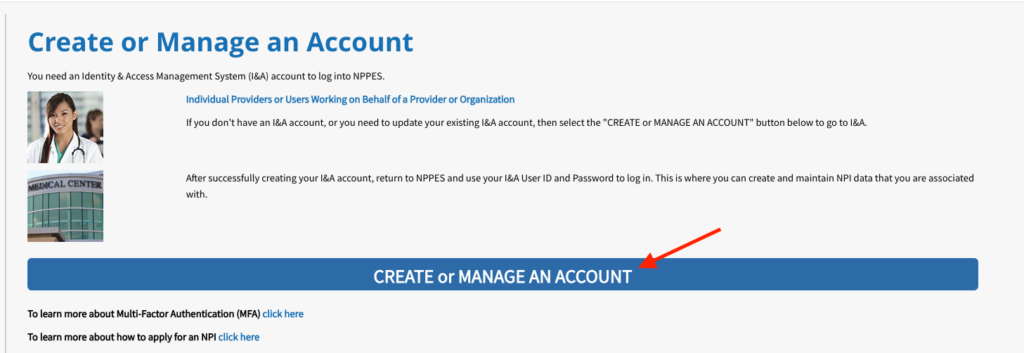
Step 1: Create Your NPPES Account

  1. Visit the National Plan and Provider Enumeration System (NPPES) website
  2. Click "Create or Manage An Account" on the NPPES home page
  3. You'll see a pop-up informing you that you're being redirected to the Identity & Access (I&A) website
  4. Click OK to proceed to the I&A website

Step 2: Complete I&A Registration

  1. Follow the prompts on the I&A website to complete your registration
  2. Create a User ID and Password
  3. IMPORTANT: Store these credentials securely—you'll need them to update your NPI information in the future
  4. Verify your email address

Step 3: Begin Your NPI Application

  1. Return to the NPPES homepage
  2. Log in with your new User ID and Password
  3. Select whether you're submitting a new NPI Application for:
    • Yourself (Type 1 - Individual)
    • Another individual (Type 1 - Individual)
    • An organization (Type 2 - Organization)
An image of the National Plan and Provider Enumeration System user interface registration page

Step 4: Complete the Application

What You'll Need:

  • Social Security Number (for individuals) or Employer Identification Number (for organizations)
  • State license number(s) (if applicable)
  • Practice address and mailing address
  • Taxonomy code for your specialty (see sidebar below)
  • Contact information including phone and email

Finding Your Taxonomy Code:

Your taxonomy code identifies your specialty. Common codes for wellness professionals:

  • 133N00000X – Dietitian/Nutritionist
  • 133V00000X – Dietitian, Registered
  • 174H00000X – Health & Wellness Coach
  • 207Q00000X – Family Medicine Physician
  • 163WP0808X – Nurse Practitioner, Psychiatric/Mental Health
  • 171M00000X – Case Manager/Care Coordinator
  • 390200000X – Student in an Organized Health Care Education/Training Program

Find the complete taxonomy code list here

Application Tips:

  • You don't have to complete the application all in one sitting—the website allows you to save your progress
  • Double-check all information for accuracy before submitting
  • Make sure your name matches exactly what's on your state license or official documents
  • Include all practice locations where you see clients

Step 5: Submit and Receive Confirmation

  1. Once you complete all sections, the system will run an error check
  2. Certify that all information is correct and complete
  3. Submit your application
  4. You'll receive:
    • A submission confirmation with a tracking number on-screen
    • A confirmation email at the contact email address you provided
    • Your NPI number via email once processed (save this email!)

Time-Saving Tip: Add [email protected] to your trusted sender list so your NPI confirmation doesn't end up in spam.

For a comprehensive step-by-step walkthrough of the online application process, CMS provides detailed instructions here.

Method 2: Apply by Mail (Less Common)

You can download and print a paper application from the CMS website. Complete the application, sign it, and mail it to the NPI Enumerator address listed on the form.

Note: Mail applications take significantly longer to process (potentially 20-30 days vs. 1-20 days for online applications). This method is generally only used by practitioners uncomfortable with online systems.

To request a hard copy application rather than printing your own:

Method 3: Apply Through a Third Party (Bulk Applications)

This option is beneficial when many providers are applying for NPI numbers simultaneously, such as when a new group practice is opening or a hospital is onboarding multiple providers.

You can give permission to an Electronic File Interchange Organization (EFIO) to send application data on your behalf.

When to use this method:

  • Your organization is enrolling multiple providers at once
  • You're part of a large health system with centralized credentialing
  • A professional organization or billing service offers this service

How Long Does It Take to Get an NPI Number?

Current processing times (as of 2026):

  • Online applications: Typically 1-20 days, with most processed within 7-10 days
  • Mail applications: 20-30 days or longer
  • Applications requiring additional verification: Up to 30 days

Factors that may extend processing time:

  • Incomplete information on your application
  • Discrepancies between your application and other official documents
  • Peak application periods (typically at the start of each year and in July when new residents begin)
  • Additional verification needed for your credentials

What to do while you wait:

  • Check your email regularly (including spam folder) for communication from [email protected]
  • Use your tracking number to check application status
  • Avoid submitting duplicate applications, which will delay processing

Your submission confirmation page will provide contact information if you need to follow up on your application.

What You'll Need Before Applying: Pre-Application Checklist

To streamline your application process, gather these items before you begin:

For Individual Practitioners (Type 1):

  • Social Security Number
  • Date and place of birth
  • State license number(s) and issuing state(s)
  • Taxonomy code for your specialty
  • Practice name (if applicable)
  • Practice mailing address
  • Practice physical location address
  • Practice phone number and fax (if applicable)
  • Contact person information (can be yourself)
  • Email address for correspondence
  • NPI numbers of any organizations where you're employed (if applicable)

For Organizations (Type 2):

  • Employer Identification Number (EIN)
  • Legal business name (exactly as registered)
  • Doing Business As" name (if different)
  • Business mailing address
  • Business physical location
  • Taxonomy code for organization type
  • Authorized official's information (name, title, contact)
  • Contact person information
  • Organization's state license number (if applicable)

Common Application Mistakes & How to Avoid Them

Mistake #1: Name Mismatches

Problem: Your name on the NPI application doesn't exactly match your state license or other credentials.Solution: Use your full legal name exactly as it appears on your license. If you've changed your name, update your license first, then apply for your NPI.

Mistake #2: Incorrect Taxonomy Code

Problem: Selecting the wrong taxonomy code can delay processing or create billing issues.Solution: Research your correct taxonomy code before applying. When in doubt, consult your professional association or contact the NPI Enumerator for guidance.

Mistake #3: Missing Practice Locations

Problem: Not listing all locations where you practice.Solution: Include every physical location where you see clients, including telehealth practice locations. You can update this information later if you add locations.

Mistake #4: Outdated Contact Information

Problem: Using an email address or phone number you don't regularly check.Solution: Use contact information you'll have long-term, as CMS may need to reach you years from now.

Mistake #5: Duplicate Applications

Problem: Submitting multiple applications because you haven't received your NPI yet.Solution: Be patient and use your tracking number to check status. Multiple applications will delay processing.

Troubleshooting: When Applications Get Rejected

If your NPI application is rejected, don't panic. Common reasons include:

Issue: Incomplete information

  • Fix: Review the rejection notice carefully and provide the missing information
  • Timeline: Usually resolved within 5-7 days once corrected information is submitted

Issue: License verification failure

  • Fix: Ensure your license is active and in good standing. Contact your state licensing board if needed.
  • Timeline: Can take 2-3 weeks depending on state processing times

Issue: Duplicate NPI detected

  • Fix: You may already have an NPI. Search the NPI Registry to check.
  • Timeline: Immediate once confirmed

Issue: Identity verification problems

  • Fix: CMS may require additional documentation. Respond promptly to any requests.
  • Timeline: 10-15 days after providing requested documentation

How to check application status:

  1. Visit the NPPES website
  2. Log in with your credentials
  3. Navigate to "Application Status"
  4. Use your tracking number to view details

Using Your NPI Across Multiple States

One of the most valuable aspects of your NPI is its portability. Your NPI number is permanent and doesn't change when you move states or practice in multiple locations.

Key Points:

Your NPI is nationwide. Unlike state licenses, you only need ONE NPI for your entire career, regardless of how many states you practice in.

Update your practice locations. When you add a new practice location in a different state, log into NPPES and update your NPI record to include the new address.

Maintain separate state licenses. While your NPI is portable, you must still maintain valid licenses in each state where you practice.

Insurance credentialing is state-specific. Even with one NPI, you'll need to credential with insurance panels separately in each state.

Multi-State Practice Example:

Dr. Martinez is a naturopathic doctor with practices in Oregon and Washington. She:

  • Has ONE Type 1 NPI for herself
  • Holds separate naturopathic licenses in Oregon and Washington
  • Has credentialed with insurance companies in both states using the same NPI
  • Lists both practice addresses in her NPI record
  • Uses the same NPI on all claims, regardless of which state the service was provided

NPI Requirements for Group Practice Owners

If you own or manage a group practice, understanding organizational NPIs is critical.

What You'll Need:

For the organization:

  • Type 2 NPI for the business entity
  • Employer Identification Number (EIN)
  • Business licenses and permits
  • Organizational taxonomy code

For each practitioner:

  • Individual Type 1 NPIs for all providers who bill insurance
  • Current state licenses for each provider
  • Individual taxonomy codes for each provider's specialty

Subpart NPIs

Some group practices may need additional NPIs for subparts of their organization. A subpart is a component of a health care provider entity that is identified separately.

Example scenarios:

  • A clinic with multiple locations may choose to get separate NPIs for each location
  • A practice with distinct service lines (e.g., physical therapy division, nutrition division)
  • Departments within a larger organization

Important: CMS has specific rules about when subparts are appropriate. Consult with your billing specialist or attorney before applying for multiple organizational NPIs.

What to Do If You've Lost Your NPI Number

It happens—you applied for an NPI years ago and can't remember the number. Here's how to find it:

Method 1: Search the NPI Registry

  1. Go to the NPI Registry
  2. Search using your name, business name, or address
  3. Your NPI and associated information will appear if you have one

Method 2: Check Past Tax Documents

Your NPI may appear on:

  • CMS-1500 claim forms you've submitted
  • Credentialing paperwork
  • Business tax returns
  • Contracts with insurance companies

Method 3: Contact NPPES

If you can't find your NPI through the registry:

  • Call 800-465-3203
  • Email [email protected]
  • Provide identifying information to verify your identity

Updating a Dormant NPI

If you haven't used your NPI in years:

  1. Search for it in the registry to confirm it's still active
  2. Log into NPPES and update any outdated information
  3. Verify all addresses and contact information are current
  4. Your NPI reactivates immediately upon updating

Important: You cannot "delete" an NPI—they're permanent. If you're no longer practicing, simply don't use it for billing, but keep the record updated with current contact information.

NPIs and Value-Based Care Contracts

As healthcare shifts toward value-based care models, your NPI plays an increasingly important role in:

Care Attribution

NPIs are used to track which providers are involved in a patient's care, essential for:

  • Accountable Care Organizations (ACOs)
  • Patient-Centered Medical Homes (PCMHs)
  • Bundled payment programs
  • Quality reporting initiatives

Demonstrating Your Impact

Your NPI allows payers and healthcare organizations to track:

  • Patient outcomes associated with your care
  • Cost savings from your interventions
  • Quality metrics and performance data
  • Population health management contributions

Why This Matters for Wellness Professionals

If you're a dietitian who helps diabetic patients improve their A1C levels, or a health coach who supports medication adherence, your NPI ensures your contributions are tracked and recognized. This data:

  • Supports expanded coverage for your services
  • Justifies reimbursement rates
  • Demonstrates the value of integrative care
  • Helps secure positions on care teams

Action step: Even if you're not currently participating in value-based contracts, having your NPI and using it consistently positions you for these opportunities as they expand.

Keeping Your NPI Information Current

Your NPI is permanent, but the information associated with it must stay current. Log into NPPES to update:

Update within 30 days when you:

  • Change practice locations
  • Change your mailing address
  • Update your legal name (marriage, legal name change)
  • Add or change taxonomy codes
  • Update contact information
  • Change organizational structure (sole proprietor to LLC, etc.)

How to Update Your Information:

  1. Log into NPPES
  2. Use your I&A credentials
  3. Select "Update Existing NPI"
  4. Make necessary changes
  5. Submit updates (usually processed within 1-3 business days)

Pro tip: Set a calendar reminder to review your NPI information annually, even if nothing has changed, to ensure everything is accurate.

Frequently Asked Questions (2026)

Q: Does my NPI expire?A: No. Your NPI is permanent and lasts your entire career. However, you must keep the associated information current.

Q: Can I have multiple NPIs?A: Individuals can only have one Type 1 NPI. However, if you own a practice, you'll also have a separate Type 2 NPI for the organization.

Q: Do I need a new NPI if I move states?A: No. Your NPI follows you regardless of location. Just update your practice address in NPPES.

Q: How much does an NPI cost?A: Nothing. Applying for and maintaining an NPI is completely free.

Q: Can I use my NPI before I'm licensed?A: Yes. Students and pre-licensed professionals can obtain NPIs and update them upon licensure.

Q: Will insurance companies accept my NPI immediately?A: Not automatically. You must separately credential with each insurance panel, though they'll require your NPI as part of that process.

Q: What's the difference between an NPI and a Tax ID (EIN)?A: Your NPI identifies you as a healthcare provider. Your Tax ID/EIN identifies your business for tax purposes. You need both for insurance billing.

Q: Do I need an NPI if I only accept cash and don't bill insurance?A: Technically no, but it's recommended. Having an NPI establishes you in the national healthcare system and provides flexibility if you decide to work with insurance later.

Q: Can I look up someone else's NPI?A: Yes. The NPI Registry is public and searchable. This helps with referrals and care coordination.

Q: What if my NPI application is denied?A: Review the denial reason, correct the issue, and resubmit. Common reasons include incomplete information or license verification problems.

Practice Better is the complete practice management platform for nutritionists, dietitians, and wellness professionals. Streamline your practice and begin your free trial today.

{{free-trial-simple-text}}

Why, When, and How to Get an NPI Number

[This blog was originally published on September 7, 2023. It was updated and refreshed for accuracy and relevance in February 2026.]

The healthcare landscape continues to evolve rapidly for wellness professionals. More insurance providers are expanding coverage for integrative and functional medicine services, telehealth has become a permanent fixture of healthcare delivery, and wellness practitioners are increasingly recognized as essential members of care teams. In this changing environment, understanding your National Provider Identifier (NPI) has never been more important.

Wellness professionals constantly deal with codes and identifiers for regulatory, billing, and administrative purposes. So, you'd be forgiven if it feels daunting to add another number to the list in the form of a National Provider Identifier (NPI). However, as insurance reimbursement becomes more accessible for nutritionists, dietitians, health coaches, and other integrative practitioners, having an NPI is quickly becoming essential—not just for current billing needs, but for positioning your practice for growth.

Whether you're currently accepting insurance or planning to in the future, this comprehensive guide covers everything you need to know about NPI numbers in 2026—from what they are to how they enable telehealth billing across state lines, to the step-by-step process for getting one of your own. Keep reading to boost your National Provider Identifier IQ!

Make insurance billing easier with Practice Better.

Getting your NPI number is just the first step — Practice Better makes managing your practice simple, including storing your NPI number for easy insurance billing.

Start your free trial today

What is an NPI number?

The Centers for Medicare & Medicaid Services (CMS) introduced the National Provider Identifier system in the United States in 2007. The intent was to standardize the identification of healthcare providers across various systems, while improving the accuracy and efficiency of electronic transactions in the industry.

  • NPI numbers are 10-digit numerical identifiers assigned to healthcare service providers in the United States – both individuals and organizations.
  • Each assigned NPI number is unique and permanent. Even if a practitioner changes jobs, locations, or states, their NPI number will always remain the same—making it invaluable in our increasingly mobile healthcare workforce.
  • An NPI number doesn't include any personal information about the individual it is assigned to, like the services provided or the practice location. It's simply an identifier to ensure accurate billing and record-keeping.

    {{claim-md-navattic-demo-simple-text}}

What is the purpose of an NPI number?

NPI numbers accurately identify care providers during electronic transactions, billing, and claims processing. They have an interdependent relationship with HIPAA (Health Insurance Portability and Accountability Act).

NPI numbers serve as unique identifiers to help with accurate data exchange and billing processes. HIPAA sets the standards for safeguarding patient information and ensuring the privacy and security of sensitive health data, including information related to NPIs. As a health and wellness professional, you need to navigate both NPI usage and HIPAA compliance to maintain the integrity of client care and data protection.

Insurance billing information under settings in the Practice Better portal.

Storing your NPI number in the Practice Better portal under Settings > All Settings and Preferences > Insurance Billing ensures your NPI number is automatically included in CMS 1500 forms, saving you precious time on tedious paperwork.

According to CMS, there are three main benefits associated with having an NPI number:

  • They simplify electronic transmission of HIPAA standard transactions.
  • They provide standard unique health identifiers for healthcare providers, healthcare plans, and employers.
  • They allow for efficient coordination of benefit transactions.

{{free-trial-simple-text}}

Who needs an NPI number?

NPI numbers are available to providers involved in patient care and engaged in electronic transactions related to healthcare services. You can get an NPI number if you provide care as defined in 45 Code of Federal Regulations (CFR) 160.103.

You MUST Get an NPI Number If:

  • You're a HIPAA-covered entity. If you transmit patient health information in electronic form in connection with a HIPAA standard transaction, you need an NPI number.
  • You're enrolling with Medicare. You must have an NPI number prior to enrolling with Medicare.
  • You're billing insurance companies. Most insurance providers require an NPI on claims forms (CMS-1500).
  • You hold a license to provide healthcare services. Licensed practitioners—including registered dietitian nutritionists (RDNs), licensed clinical social workers, nurse practitioners, naturopathic doctors, chiropractors, and many others—are likely to need an NPI number.
  • You provide mental health services. Those offering counseling, psychotherapy, and behavioral therapy are often required to have an NPI.

Wellness Practitioners & Emerging Professions (2026)

The landscape has expanded in recent years. The following practitioners may also need or benefit from having an NPI:

  • Health and Wellness Coaches – As of 2022, health coaches can obtain NPIs using the Health and Wellness Coach taxonomy code (174H00000X), especially valuable for those working in provider settings or hospital systems.
  • Registered Behavior Technicians (RBTs) – Often required for insurance billing in behavioral health settings.
  • Lactation Consultants (IBCLCs) – International Board Certified Lactation Consultants commonly need NPIs for insurance reimbursement.
  • Certified Diabetes Care and Education Specialists (CDCES) – Increasingly seeking reimbursement for diabetes education services.
  • Doulas and Birth Workers – Some states and insurance plans are beginning to cover these services, requiring NPIs.
  • Acupuncturists and Alternative Medicine Practitioners – Depending on state regulations and scope of practice.

The Gray Area: Do Health Coaches Need NPIs?

This is one of the most common questions we receive in 2026. The short answer: it depends on your practice structure and goals.

  • You DON'T need an NPI if you're operating purely as a wellness coach outside of medical settings, don't bill insurance, and aren't part of a healthcare organization's care team.
  • You SHOULD get an NPI if you're working within an integrated healthcare setting, want the option to bill insurance in the future, or are part of a care coordination team where documentation requires provider identification.
  • Professional recognition matters. Even if not legally required, having an NPI adds professional credibility and demonstrates you're a recognized healthcare provider in the national system.

Pro Tip: The Academy of Nutrition and Dietetics strongly recommends all registered dietitian nutritionists obtain NPIs regardless of their work setting, as it helps demonstrate workforce capacity to insurance companies and policymakers. Consider applying the same logic to your practice—even if you don't need it today, you might tomorrow.

Understanding NPI Types: Type 1 vs. Type 2

an image showing the 2 types of NPI numbers.
According to CMS, if you’re an individual healthcare provider who’s incorporated, you may need to get an NPI for yourself (Entity Type 1) and an NPI for your corporation or LLC (Entity Type 2).

There are two types of NPIs, and understanding which one(s) you need is crucial:

Type 1 (Individual NPI)

Assigned to individual healthcare providers such as:

  • Physicians, nurse practitioners, physician assistants
  • Dietitians, nutritionists, health coaches
  • Therapists, counselors, social workers
  • Chiropractors, acupuncturists, naturopathic doctors

Key point: Your individual NPI follows you throughout your entire career, regardless of where you work or how many times you change employers.

Type 2 (Organizational NPI)

Assigned to healthcare organizations such as:

  • Group practices and clinics
  • Hospitals and health systems
  • Corporations and LLCs providing healthcare services
  • Pharmacies, laboratories, and medical equipment companies

Do You Need Both?

According to CMS, if you're an individual healthcare provider who's incorporated, you may need to get an NPI for yourself (Type 1) AND an NPI for your corporation or LLC (Type 2).

Example: You're a naturopathic doctor who operates as "Dr. Smith Integrative Medicine, LLC." You would apply for:

  • A Type 1 NPI for yourself as Dr. Smith
  • A Type 2 NPI for your business entity "Dr. Smith Integrative Medicine, LLC"

To contextualize this further, imagine you operate a naturopathic clinic offering a range of services delivered by licensed professionals, including acupuncture, herbal medicine, nutritional counseling, and wellness workshops. From an administrative perspective, treating each of these as subparts allows you to track services, bill accurately, and provide a seamless experience to your clients. In this case, each subpart would need its own unique NPI to make for easier electronic transactions and accurate record keeping.

NPI Numbers and Telehealth Billing in 2026

One of the most significant developments in recent years has been the permanent expansion of telehealth services. Your NPI plays a critical role in enabling telehealth billing and reimbursement.

Cross-State Telehealth Practice

Your NPI doesn't change based on location. This is particularly valuable for telehealth practitioners who see clients across multiple states. While your NPI remains constant, remember that:

  • State licensure requirements still apply. You must hold a valid license in each state where you're providing care, but you only need ONE NPI.
  • Some states participate in licensure compacts (like the Interstate Medical Licensure Compact), making multi-state practice easier.
  • Insurance credentialing is state-specific. Even with one NPI, you'll need to credential with insurance panels in each state where you practice.

Telehealth Billing Best Practices

  • Include your NPI on all telehealth claims, just as you would for in-person visits
  • Use the appropriate place of service code (02 for telehealth)
  • Ensure your NPI record includes all practice locations, including your telehealth practice address
  • Keep your NPI information current as you expand to new states

NPIs and Mental Health Parity Compliance

With the expansion of the Mental Health Parity and Addiction Equity Act, more wellness professionals providing mental health and behavioral health services are finding their services covered by insurance. Your NPI is essential for compliance and reimbursement in this space.

What This Means for Wellness Professionals

  • Health coaches working with behavioral change may find opportunities for reimbursement under mental health benefit categories
  • Nutritionists treating eating disorders often need NPIs to bill under mental health parity provisions
  • Stress management and wellness specialists may qualify for coverage under preventive mental health services

Having your NPI ready positions you to take advantage of these expanding coverage opportunities.

Can you apply for NPI number without a license?

Yes, you can apply for an NPI number without having a professional license. The NPI system was designed to create a standardized identifier for accurate data exchange, coordination of benefits, claims processing, and billing. Not all individuals involved in those activities are licensed providers.

However, whether you NEED an NPI without a license depends on your role:

  • Non-licensed roles that may need NPIs: Administrative staff handling billing, case managers, care coordinators, health coaches in certain settings
  • Consider getting an NPI if: You're a student in a healthcare training program, as you can update it upon graduation and licensure
  • When NOT to apply without a license: If you're providing unlicensed services outside of healthcare settings and not involved in billing or care coordination

How to obtain an NPI number

Three are three ways to apply for an NPI number: online, by mail, or through a third party.

Method 1: Apply Online (RECOMMENDED)

The online application is the fastest and most efficient method. Here's the step-by-step process:

Step 1: Create Your NPPES Account

  1. Visit the National Plan and Provider Enumeration System (NPPES) website
  2. Click "Create or Manage An Account" on the NPPES home page
  3. You'll see a pop-up informing you that you're being redirected to the Identity & Access (I&A) website
  4. Click OK to proceed to the I&A website

Step 2: Complete I&A Registration

  1. Follow the prompts on the I&A website to complete your registration
  2. Create a User ID and Password
  3. IMPORTANT: Store these credentials securely—you'll need them to update your NPI information in the future
  4. Verify your email address

Step 3: Begin Your NPI Application

  1. Return to the NPPES homepage
  2. Log in with your new User ID and Password
  3. Select whether you're submitting a new NPI Application for:
    • Yourself (Type 1 - Individual)
    • Another individual (Type 1 - Individual)
    • An organization (Type 2 - Organization)
An image of the National Plan and Provider Enumeration System user interface registration page

Step 4: Complete the Application

What You'll Need:

  • Social Security Number (for individuals) or Employer Identification Number (for organizations)
  • State license number(s) (if applicable)
  • Practice address and mailing address
  • Taxonomy code for your specialty (see sidebar below)
  • Contact information including phone and email

Finding Your Taxonomy Code:

Your taxonomy code identifies your specialty. Common codes for wellness professionals:

  • 133N00000X – Dietitian/Nutritionist
  • 133V00000X – Dietitian, Registered
  • 174H00000X – Health & Wellness Coach
  • 207Q00000X – Family Medicine Physician
  • 163WP0808X – Nurse Practitioner, Psychiatric/Mental Health
  • 171M00000X – Case Manager/Care Coordinator
  • 390200000X – Student in an Organized Health Care Education/Training Program

Find the complete taxonomy code list here

Application Tips:

  • You don't have to complete the application all in one sitting—the website allows you to save your progress
  • Double-check all information for accuracy before submitting
  • Make sure your name matches exactly what's on your state license or official documents
  • Include all practice locations where you see clients

Step 5: Submit and Receive Confirmation

  1. Once you complete all sections, the system will run an error check
  2. Certify that all information is correct and complete
  3. Submit your application
  4. You'll receive:
    • A submission confirmation with a tracking number on-screen
    • A confirmation email at the contact email address you provided
    • Your NPI number via email once processed (save this email!)

Time-Saving Tip: Add [email protected] to your trusted sender list so your NPI confirmation doesn't end up in spam.

For a comprehensive step-by-step walkthrough of the online application process, CMS provides detailed instructions here.

Method 2: Apply by Mail (Less Common)

You can download and print a paper application from the CMS website. Complete the application, sign it, and mail it to the NPI Enumerator address listed on the form.

Note: Mail applications take significantly longer to process (potentially 20-30 days vs. 1-20 days for online applications). This method is generally only used by practitioners uncomfortable with online systems.

To request a hard copy application rather than printing your own:

Method 3: Apply Through a Third Party (Bulk Applications)

This option is beneficial when many providers are applying for NPI numbers simultaneously, such as when a new group practice is opening or a hospital is onboarding multiple providers.

You can give permission to an Electronic File Interchange Organization (EFIO) to send application data on your behalf.

When to use this method:

  • Your organization is enrolling multiple providers at once
  • You're part of a large health system with centralized credentialing
  • A professional organization or billing service offers this service

How Long Does It Take to Get an NPI Number?

Current processing times (as of 2026):

  • Online applications: Typically 1-20 days, with most processed within 7-10 days
  • Mail applications: 20-30 days or longer
  • Applications requiring additional verification: Up to 30 days

Factors that may extend processing time:

  • Incomplete information on your application
  • Discrepancies between your application and other official documents
  • Peak application periods (typically at the start of each year and in July when new residents begin)
  • Additional verification needed for your credentials

What to do while you wait:

  • Check your email regularly (including spam folder) for communication from [email protected]
  • Use your tracking number to check application status
  • Avoid submitting duplicate applications, which will delay processing

Your submission confirmation page will provide contact information if you need to follow up on your application.

What You'll Need Before Applying: Pre-Application Checklist

To streamline your application process, gather these items before you begin:

For Individual Practitioners (Type 1):

  • Social Security Number
  • Date and place of birth
  • State license number(s) and issuing state(s)
  • Taxonomy code for your specialty
  • Practice name (if applicable)
  • Practice mailing address
  • Practice physical location address
  • Practice phone number and fax (if applicable)
  • Contact person information (can be yourself)
  • Email address for correspondence
  • NPI numbers of any organizations where you're employed (if applicable)

For Organizations (Type 2):

  • Employer Identification Number (EIN)
  • Legal business name (exactly as registered)
  • Doing Business As" name (if different)
  • Business mailing address
  • Business physical location
  • Taxonomy code for organization type
  • Authorized official's information (name, title, contact)
  • Contact person information
  • Organization's state license number (if applicable)

Common Application Mistakes & How to Avoid Them

Mistake #1: Name Mismatches

Problem: Your name on the NPI application doesn't exactly match your state license or other credentials.Solution: Use your full legal name exactly as it appears on your license. If you've changed your name, update your license first, then apply for your NPI.

Mistake #2: Incorrect Taxonomy Code

Problem: Selecting the wrong taxonomy code can delay processing or create billing issues.Solution: Research your correct taxonomy code before applying. When in doubt, consult your professional association or contact the NPI Enumerator for guidance.

Mistake #3: Missing Practice Locations

Problem: Not listing all locations where you practice.Solution: Include every physical location where you see clients, including telehealth practice locations. You can update this information later if you add locations.

Mistake #4: Outdated Contact Information

Problem: Using an email address or phone number you don't regularly check.Solution: Use contact information you'll have long-term, as CMS may need to reach you years from now.

Mistake #5: Duplicate Applications

Problem: Submitting multiple applications because you haven't received your NPI yet.Solution: Be patient and use your tracking number to check status. Multiple applications will delay processing.

Troubleshooting: When Applications Get Rejected

If your NPI application is rejected, don't panic. Common reasons include:

Issue: Incomplete information

  • Fix: Review the rejection notice carefully and provide the missing information
  • Timeline: Usually resolved within 5-7 days once corrected information is submitted

Issue: License verification failure

  • Fix: Ensure your license is active and in good standing. Contact your state licensing board if needed.
  • Timeline: Can take 2-3 weeks depending on state processing times

Issue: Duplicate NPI detected

  • Fix: You may already have an NPI. Search the NPI Registry to check.
  • Timeline: Immediate once confirmed

Issue: Identity verification problems

  • Fix: CMS may require additional documentation. Respond promptly to any requests.
  • Timeline: 10-15 days after providing requested documentation

How to check application status:

  1. Visit the NPPES website
  2. Log in with your credentials
  3. Navigate to "Application Status"
  4. Use your tracking number to view details

Using Your NPI Across Multiple States

One of the most valuable aspects of your NPI is its portability. Your NPI number is permanent and doesn't change when you move states or practice in multiple locations.

Key Points:

Your NPI is nationwide. Unlike state licenses, you only need ONE NPI for your entire career, regardless of how many states you practice in.

Update your practice locations. When you add a new practice location in a different state, log into NPPES and update your NPI record to include the new address.

Maintain separate state licenses. While your NPI is portable, you must still maintain valid licenses in each state where you practice.

Insurance credentialing is state-specific. Even with one NPI, you'll need to credential with insurance panels separately in each state.

Multi-State Practice Example:

Dr. Martinez is a naturopathic doctor with practices in Oregon and Washington. She:

  • Has ONE Type 1 NPI for herself
  • Holds separate naturopathic licenses in Oregon and Washington
  • Has credentialed with insurance companies in both states using the same NPI
  • Lists both practice addresses in her NPI record
  • Uses the same NPI on all claims, regardless of which state the service was provided

NPI Requirements for Group Practice Owners

If you own or manage a group practice, understanding organizational NPIs is critical.

What You'll Need:

For the organization:

  • Type 2 NPI for the business entity
  • Employer Identification Number (EIN)
  • Business licenses and permits
  • Organizational taxonomy code

For each practitioner:

  • Individual Type 1 NPIs for all providers who bill insurance
  • Current state licenses for each provider
  • Individual taxonomy codes for each provider's specialty

Subpart NPIs

Some group practices may need additional NPIs for subparts of their organization. A subpart is a component of a health care provider entity that is identified separately.

Example scenarios:

  • A clinic with multiple locations may choose to get separate NPIs for each location
  • A practice with distinct service lines (e.g., physical therapy division, nutrition division)
  • Departments within a larger organization

Important: CMS has specific rules about when subparts are appropriate. Consult with your billing specialist or attorney before applying for multiple organizational NPIs.

What to Do If You've Lost Your NPI Number

It happens—you applied for an NPI years ago and can't remember the number. Here's how to find it:

Method 1: Search the NPI Registry

  1. Go to the NPI Registry
  2. Search using your name, business name, or address
  3. Your NPI and associated information will appear if you have one

Method 2: Check Past Tax Documents

Your NPI may appear on:

  • CMS-1500 claim forms you've submitted
  • Credentialing paperwork
  • Business tax returns
  • Contracts with insurance companies

Method 3: Contact NPPES

If you can't find your NPI through the registry:

  • Call 800-465-3203
  • Email [email protected]
  • Provide identifying information to verify your identity

Updating a Dormant NPI

If you haven't used your NPI in years:

  1. Search for it in the registry to confirm it's still active
  2. Log into NPPES and update any outdated information
  3. Verify all addresses and contact information are current
  4. Your NPI reactivates immediately upon updating

Important: You cannot "delete" an NPI—they're permanent. If you're no longer practicing, simply don't use it for billing, but keep the record updated with current contact information.

NPIs and Value-Based Care Contracts

As healthcare shifts toward value-based care models, your NPI plays an increasingly important role in:

Care Attribution

NPIs are used to track which providers are involved in a patient's care, essential for:

  • Accountable Care Organizations (ACOs)
  • Patient-Centered Medical Homes (PCMHs)
  • Bundled payment programs
  • Quality reporting initiatives

Demonstrating Your Impact

Your NPI allows payers and healthcare organizations to track:

  • Patient outcomes associated with your care
  • Cost savings from your interventions
  • Quality metrics and performance data
  • Population health management contributions

Why This Matters for Wellness Professionals

If you're a dietitian who helps diabetic patients improve their A1C levels, or a health coach who supports medication adherence, your NPI ensures your contributions are tracked and recognized. This data:

  • Supports expanded coverage for your services
  • Justifies reimbursement rates
  • Demonstrates the value of integrative care
  • Helps secure positions on care teams

Action step: Even if you're not currently participating in value-based contracts, having your NPI and using it consistently positions you for these opportunities as they expand.

Keeping Your NPI Information Current

Your NPI is permanent, but the information associated with it must stay current. Log into NPPES to update:

Update within 30 days when you:

  • Change practice locations
  • Change your mailing address
  • Update your legal name (marriage, legal name change)
  • Add or change taxonomy codes
  • Update contact information
  • Change organizational structure (sole proprietor to LLC, etc.)

How to Update Your Information:

  1. Log into NPPES
  2. Use your I&A credentials
  3. Select "Update Existing NPI"
  4. Make necessary changes
  5. Submit updates (usually processed within 1-3 business days)

Pro tip: Set a calendar reminder to review your NPI information annually, even if nothing has changed, to ensure everything is accurate.

Frequently Asked Questions (2026)

Q: Does my NPI expire?A: No. Your NPI is permanent and lasts your entire career. However, you must keep the associated information current.

Q: Can I have multiple NPIs?A: Individuals can only have one Type 1 NPI. However, if you own a practice, you'll also have a separate Type 2 NPI for the organization.

Q: Do I need a new NPI if I move states?A: No. Your NPI follows you regardless of location. Just update your practice address in NPPES.

Q: How much does an NPI cost?A: Nothing. Applying for and maintaining an NPI is completely free.

Q: Can I use my NPI before I'm licensed?A: Yes. Students and pre-licensed professionals can obtain NPIs and update them upon licensure.

Q: Will insurance companies accept my NPI immediately?A: Not automatically. You must separately credential with each insurance panel, though they'll require your NPI as part of that process.

Q: What's the difference between an NPI and a Tax ID (EIN)?A: Your NPI identifies you as a healthcare provider. Your Tax ID/EIN identifies your business for tax purposes. You need both for insurance billing.

Q: Do I need an NPI if I only accept cash and don't bill insurance?A: Technically no, but it's recommended. Having an NPI establishes you in the national healthcare system and provides flexibility if you decide to work with insurance later.

Q: Can I look up someone else's NPI?A: Yes. The NPI Registry is public and searchable. This helps with referrals and care coordination.

Q: What if my NPI application is denied?A: Review the denial reason, correct the issue, and resubmit. Common reasons include incomplete information or license verification problems.

Practice Better is the complete practice management platform for nutritionists, dietitians, and wellness professionals. Streamline your practice and begin your free trial today.

{{free-trial-simple-text}}

Manage every step of the claims process with confidence and speed
Check out the interactive demo and discover how you can submit insurance claims securely and reliably with Practice Better's Claim.MD integration
Manage every step of the claims process with confidence and speed
Check out the interactive demo and discover how you can submit insurance claims securely and reliably with Practice Better's Claim.MD integration
Try Practice Better for free
Build your dream practice with a modern, all-in-one EHR that supports the holistic health of your clients and your business.
Try Practice Better for free
Build your dream practice with a modern, all-in-one EHR that supports the holistic health of your clients and your business.
Proudly Serving

Location
Specialty
Customer Since

's Top Features

No items found.

Experience the platform that powers success for you and your clients

Try any paid plan free.