
SOAP stands for subjective, objective, assessment, and plan. Those are the four sections of a SOAP note, a form of written documentation that many healthcare professions use to record a patient or client interaction (Purdue OWL). StatPearls credits Larry Weed with developing the structure, and describes it as a widely used documentation method for clinicians (StatPearls, NCBI Bookshelf).
This page covers what the acronym means. For the mechanics of writing each section, see how to write a SOAP note. For finished notes across eight disciplines, see SOAP note examples.
Each letter names one section, and each section holds one kind of information.
| Letter | Section | What goes in it |
|---|---|---|
| S | Subjective | What the client tells you about their complaint and their experience of their symptoms, centered on the chief complaint that brought them in |
| O | Objective | Quantifiable data: lab results, physical exam findings, vitals, and your own observations of the client |
| A | Assessment | Your evaluation of the subjective and objective information, plus the client's progress or changes across sessions |
| P | Plan | Your recommended treatment plan and the next steps |
Source for the section contents: Practice Better's guide to writing a SOAP note.
The order carries meaning too. Subjective comes from the client. Objective comes from your measurements and observations. Assessment is where your interpretation enters, and it draws on the two sections above it. Plan turns that assessment into action.
Larry Weed developed the SOAP note structure, according to StatPearls, which puts its origin almost 50 years before the entry's 2023 update (StatPearls).
StatPearls describes two jobs the structure does. It reminds clinicians of specific tasks while giving them a framework for evaluating information, and it provides a cognitive framework for clinical reasoning.
Weed's format asks you to gather what the client says and what you observe before you interpret either one.
SOAP notes record a patient's health status in a fixed order so the people involved in their care can read it. StatPearls states that SOAP notes facilitate communication among healthcare professionals, and that the structure serves as a checklist, a cognitive aid, and a potential index for retrieving information from the record (StatPearls).
Purdue OWL frames the purpose around care quality: a good SOAP note helps healthcare professionals document, then recall and apply, the details of a specific case (Purdue OWL).
A quick test for your own notes: if a colleague opened your last note with no other context, could they tell what the client reported, what you found, what you concluded, and what happens next? If any of those four answers is missing, one section is doing too little.
Clinicians across many healthcare professions write SOAP notes. Purdue OWL describes SOAP notes as documentation that many healthcare professions use, and notes that a broad range of fields employ them (Purdue OWL).
In wellness care, Practice Better describes SOAP as the standard format for functional medicine practitioners (charting software for dietitians and nutritionists). The SOAP note examples page shows the format at work for dietitians, health coaches, functional medicine practitioners, counselors, physical and occupational therapists, massage therapists, and chiropractors.
Yes. The StatPearls entry on SOAP notes, last updated in August 2023, describes the SOAP note as a widely used documentation method for clinicians and says the structure is widely adopted (StatPearls).
The four letters mean the same thing in every discipline. What fills each section changes with the work.
A massage therapist's objective section records different findings from a dietitian's, and a counselor's assessment draws on different reasoning from a chiropractor's. The SOAP note examples page runs the same four sections through eight disciplines so you can see that shift directly.
Some disciplines use a different format entirely. ADIME (assessment, diagnosis, intervention, monitoring, evaluation) is the standard charting format for registered dietitians (Practice Better). If you are weighing the two, ADIME vs SOAP notes compares them side by side. Counselors can find section-by-section guidance in SOAP notes in counseling.
Knowing what the letters mean is the starting point. Writing the note well is a separate skill, and the step-by-step guide to writing a SOAP note covers it section by section, with a free SOAP note template you can download.
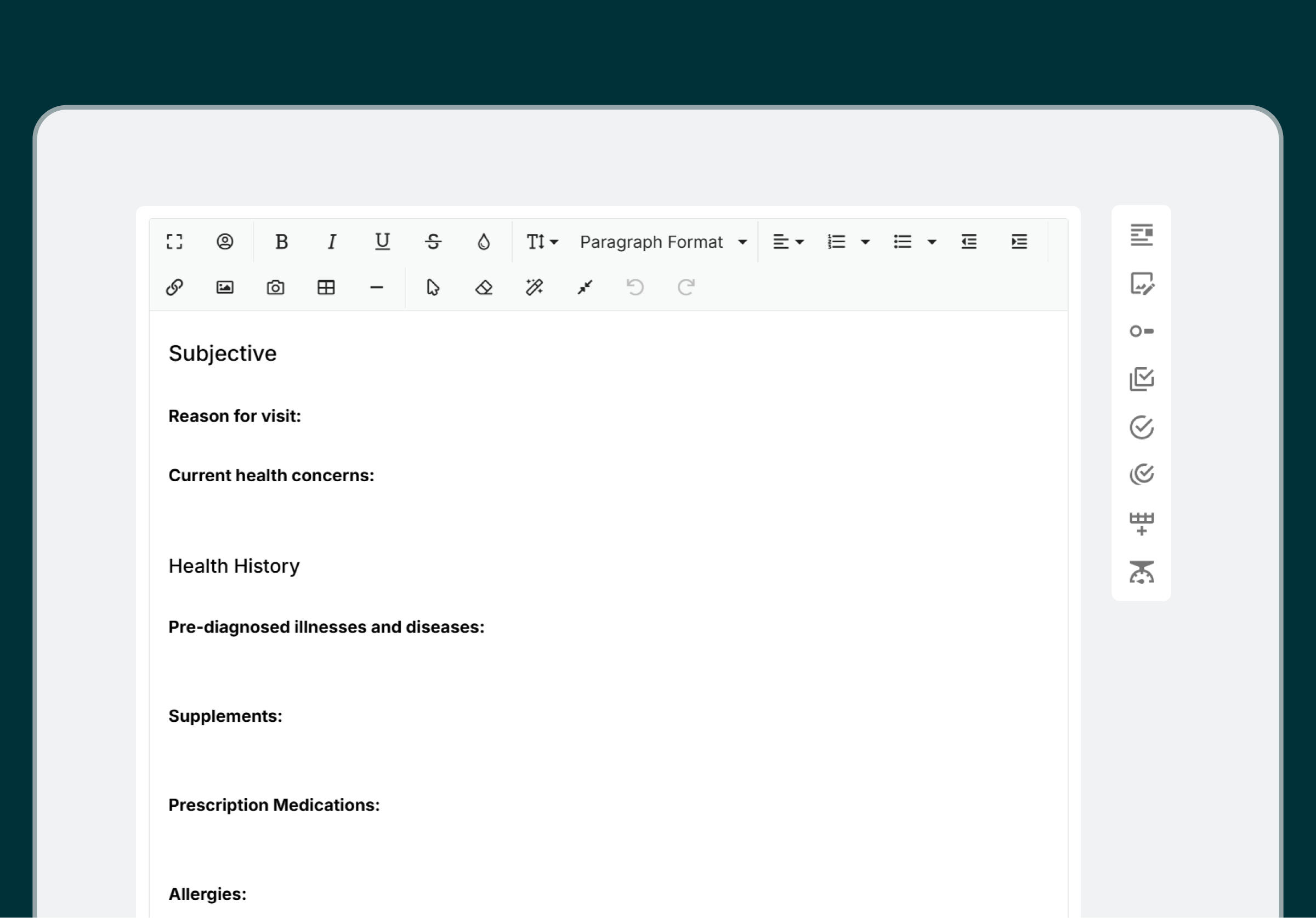
In Practice Better, you can document every client session in SOAP, DAP, BIRP, or a fully custom format, and attach notes directly to the client's profile (charting). You can also set a SOAP note template to share only the plan section with your client, so they have their next steps without seeing the rest of your note (note templates).
Start a free trial of Practice Better to chart your sessions in the format you already use.
{{soap-note-template}}
{{free-trial-simple-text}}

SOAP stands for subjective, objective, assessment, and plan. Those are the four sections of a SOAP note, a form of written documentation that many healthcare professions use to record a patient or client interaction (Purdue OWL). StatPearls credits Larry Weed with developing the structure, and describes it as a widely used documentation method for clinicians (StatPearls, NCBI Bookshelf).
This page covers what the acronym means. For the mechanics of writing each section, see how to write a SOAP note. For finished notes across eight disciplines, see SOAP note examples.
Each letter names one section, and each section holds one kind of information.
| Letter | Section | What goes in it |
|---|---|---|
| S | Subjective | What the client tells you about their complaint and their experience of their symptoms, centered on the chief complaint that brought them in |
| O | Objective | Quantifiable data: lab results, physical exam findings, vitals, and your own observations of the client |
| A | Assessment | Your evaluation of the subjective and objective information, plus the client's progress or changes across sessions |
| P | Plan | Your recommended treatment plan and the next steps |
Source for the section contents: Practice Better's guide to writing a SOAP note.
The order carries meaning too. Subjective comes from the client. Objective comes from your measurements and observations. Assessment is where your interpretation enters, and it draws on the two sections above it. Plan turns that assessment into action.
Larry Weed developed the SOAP note structure, according to StatPearls, which puts its origin almost 50 years before the entry's 2023 update (StatPearls).
StatPearls describes two jobs the structure does. It reminds clinicians of specific tasks while giving them a framework for evaluating information, and it provides a cognitive framework for clinical reasoning.
Weed's format asks you to gather what the client says and what you observe before you interpret either one.
SOAP notes record a patient's health status in a fixed order so the people involved in their care can read it. StatPearls states that SOAP notes facilitate communication among healthcare professionals, and that the structure serves as a checklist, a cognitive aid, and a potential index for retrieving information from the record (StatPearls).
Purdue OWL frames the purpose around care quality: a good SOAP note helps healthcare professionals document, then recall and apply, the details of a specific case (Purdue OWL).
A quick test for your own notes: if a colleague opened your last note with no other context, could they tell what the client reported, what you found, what you concluded, and what happens next? If any of those four answers is missing, one section is doing too little.
Clinicians across many healthcare professions write SOAP notes. Purdue OWL describes SOAP notes as documentation that many healthcare professions use, and notes that a broad range of fields employ them (Purdue OWL).
In wellness care, Practice Better describes SOAP as the standard format for functional medicine practitioners (charting software for dietitians and nutritionists). The SOAP note examples page shows the format at work for dietitians, health coaches, functional medicine practitioners, counselors, physical and occupational therapists, massage therapists, and chiropractors.
Yes. The StatPearls entry on SOAP notes, last updated in August 2023, describes the SOAP note as a widely used documentation method for clinicians and says the structure is widely adopted (StatPearls).
The four letters mean the same thing in every discipline. What fills each section changes with the work.
A massage therapist's objective section records different findings from a dietitian's, and a counselor's assessment draws on different reasoning from a chiropractor's. The SOAP note examples page runs the same four sections through eight disciplines so you can see that shift directly.
Some disciplines use a different format entirely. ADIME (assessment, diagnosis, intervention, monitoring, evaluation) is the standard charting format for registered dietitians (Practice Better). If you are weighing the two, ADIME vs SOAP notes compares them side by side. Counselors can find section-by-section guidance in SOAP notes in counseling.
Knowing what the letters mean is the starting point. Writing the note well is a separate skill, and the step-by-step guide to writing a SOAP note covers it section by section, with a free SOAP note template you can download.
In Practice Better, you can document every client session in SOAP, DAP, BIRP, or a fully custom format, and attach notes directly to the client's profile (charting). You can also set a SOAP note template to share only the plan section with your client, so they have their next steps without seeing the rest of your note (note templates).
Start a free trial of Practice Better to chart your sessions in the format you already use.
{{soap-note-template}}
{{free-trial-simple-text}}




%202.png)


