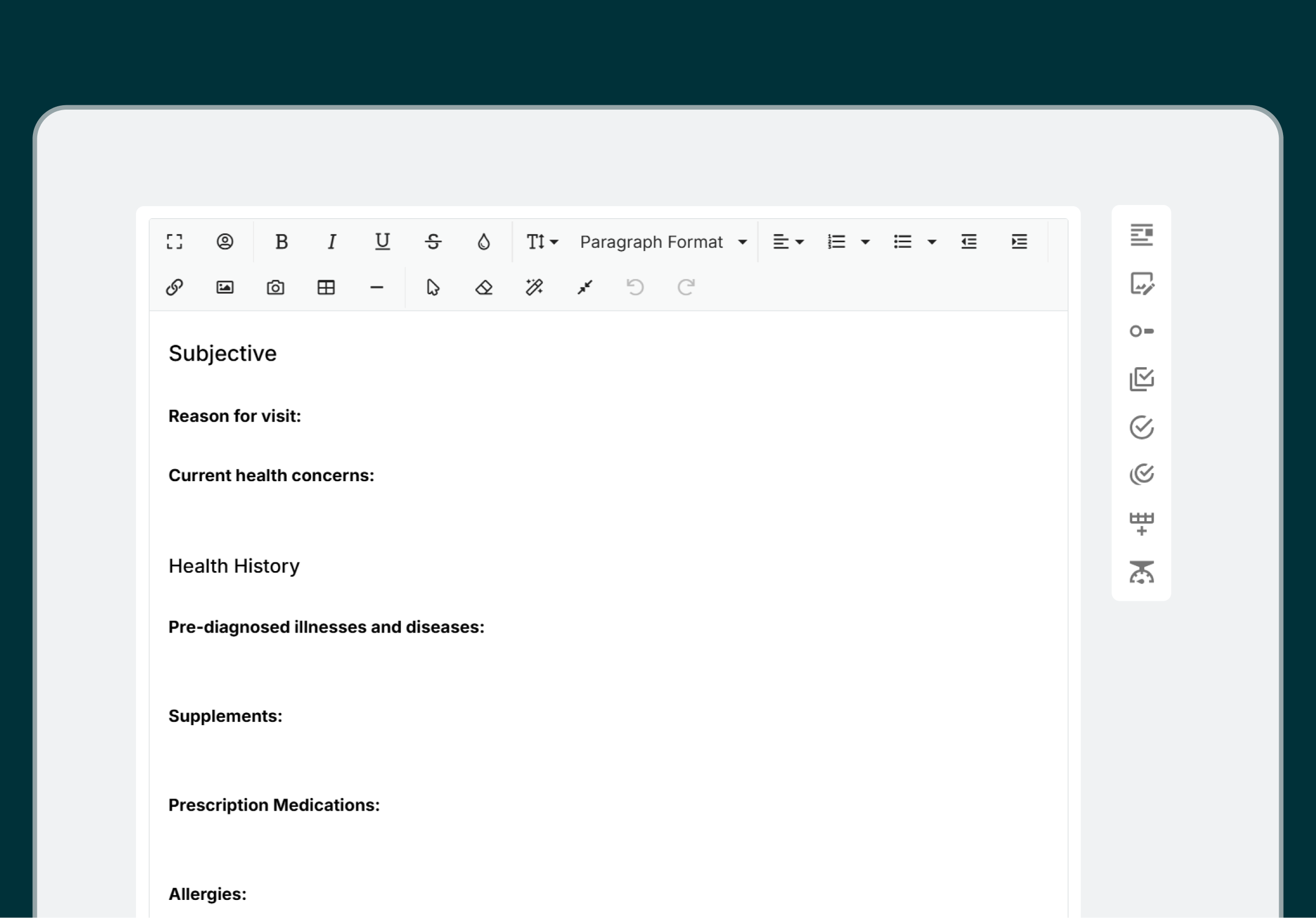
A treatment plan template is a reusable form for the plan you and a client agree on: the problems you are working on, the goals, the short-term objectives with target dates, and the interventions you will use to reach them. The behavioral health treatment plan template published on the Agency for Healthcare Research and Quality's (AHRQ) integration site uses exactly those fields, plus client strengths, discharge criteria, and signature lines (AHRQ Academy treatment plan template). Written well, the objectives give you something to measure progress against at every review.
This guide gives you a template to copy, a method for writing goals and objectives you can measure, and three worked examples: two for therapists and counselors, and one for dietitians and nutritionists. For the broader plan that sits around clinical treatment, see our care plan template guide.
Every example here is illustrative. The clients are invented composites written to show the format. Clinical choices in the examples belong to the treating clinician.
A treatment plan holds eight things: who the client is, what you are treating, where the client wants to end up, what they bring to the work, the measurable steps toward that end, what you will do in sessions, what has to be true for treatment to end, and who signed the plan. The AHRQ template gives each one its own field (AHRQ Academy):
| Section | What goes there |
|---|---|
| Client details | Name, date of birth, referring provider, diagnosis, date the plan was created |
| Problems | Each problem the plan addresses |
| Long-term goals | The change the client wants by the end of treatment |
| Strengths and assets | What the client brings that supports the work |
| Short-term goals and objectives | Measurable steps toward each long-term goal, with a target date and a date completed |
| Interventions | The method, its frequency, and who delivers it |
| Discharge criteria | What has to be true for treatment to end |
| Signatures | Client, guardian if needed, clinician, and provider, with revision dates |
The template below adds two fields we would argue for: a measure column, so every objective names how progress will be checked, and a review date, so the plan carries its own reminder to look at it again.
Copy this layout into your note template or a form. One row per objective keeps the plan readable when a client has more than one problem.
Client: ______ Date of birth: ______ Plan created: ______ Review date: ______Referring provider: ______ Diagnosis or reason for referral: ______
Problem 1: ______Long-term goal: ______Strengths and assets: ______
| Objective | Measure | Target date | Date met | Intervention (method, frequency, who) |
|---|---|---|---|---|
| 1a. | ||||
| 1b. |
Discharge criteria: ______
Client agreement: The plan and its risks and benefits were explained to the client, and a copy was offered. Accepted ☐ Declined ☐
Signatures: client, guardian if needed, clinician with credentials, date.
Repeat the problem block for each problem. If you bill insurance, check your payers' documentation requirements and add any field they ask for.
Write the goal as the broad change the client wants, then write objectives as the specific, measurable steps that show the goal is getting closer. The Centers for Disease Control and Prevention (CDC) draws the same line in its guide to writing objectives: goals are broad statements of the long-term effect you want, and objectives are more immediate results that serve as the basis for monitoring progress (CDC, Writing SMART Objectives).
The CDC brief defines a SMART objective as:
The same brief advises against verbs like "understand" or "know," which are hard to measure, in favor of verbs that describe an action (CDC).
| Vague objective | Measurable objective |
|---|---|
| Client will understand their anxiety triggers. | By week 4, client will list three situations that set off worry, from their own log. |
| Client will feel less depressed. | By the 12-week review, client's PHQ-9 score will be lower than the intake score. |
| Client will eat better. | By week 6, client will log lunch in their food journal on five of seven days. |
You write a treatment plan in seven steps: name the problem, write the long-term goal, break it into objectives, choose the interventions, pick the measure, set the review date and discharge criteria, and review it with the client.
Your session notes then carry the plan forward. Each note should say which objective the session worked on. For note formats, see SOAP note examples and how to write a SOAP note.
Below are three composite treatment plans, each showing one problem worked through the template. The first two are for therapists and counselors. The third shows the same structure in a nutrition practice. Each plan is shown as written at intake, so the Date met column is still empty.
Composite scenario: adult client, referred by their primary care provider, with a diagnosis of generalized anxiety disorder recorded at intake.
Problem: worry about work that the client describes as constant, and avoidance of speaking in team meetings.
Long-term goal: "I want to get through a work week without the worry running my day."
Strengths and assets: steady job, a supportive partner, keeps a daily journal already.
| Objective | Measure | Target date | Date met | Intervention |
|---|---|---|---|---|
| 1a. Client will log worry episodes daily, noting the situation and a 0 to 10 rating. | Log completed on five of seven days | Week 2 | Cognitive behavioral therapy (CBT), weekly 50-minute sessions, treating counselor | |
| 1b. Client will list three situations that set off worry, drawn from their log. | List reviewed in session | Week 4 | CBT, as above | |
| 1c. Client will speak at least once in three team meetings. | Client report, tracked in log | Week 10 | CBT, as above | |
| 1d. Client's GAD-7 score will be lower than the intake score. | GAD-7 at intake and at review | 12-week review | GAD-7 sent as a form before the review session |
Discharge criteria: objectives 1a to 1d met, and the client and counselor agree the long-term goal is reached.
Why these choices: the National Institute of Mental Health (NIMH) describes CBT as a research-supported psychotherapy commonly used to treat generalized anxiety disorder (NIMH, Generalized Anxiety Disorder). The GAD-7 is a seven-item self-report scale its developers found valid for screening generalized anxiety disorder and assessing its severity (Spitzer et al., Archives of Internal Medicine). The behavioral objectives sit next to the score so the plan tracks what the client can do as well as how they rate their symptoms.
Composite scenario: adult client, self-referred, with a diagnosis of depression recorded at intake. The client describes withdrawing from friends after a move.
Problem: low mood and pulling away from relationships since relocating for work.
Long-term goal: "I want to feel like I have people here."
Strengths and assets: close relationship with a sibling, enjoys running, motivated to attend sessions.
| Objective | Measure | Target date | Date met | Intervention |
|---|---|---|---|---|
| 2a. Client will name two relationships they want to strengthen or start. | Named in session and recorded in note | Week 3 | Interpersonal therapy, weekly sessions, treating therapist | |
| 2b. Client will make contact with one of those people each week. | Weekly count, client report | Weeks 4 to 10 | Interpersonal therapy, as above | |
| 2c. Client's PHQ-9 score will be lower than the intake score. | PHQ-9 at intake, week 6, and review | 12-week review | PHQ-9 sent as a form before sessions 1, 6, and 12 |
Discharge criteria: objectives 2a to 2c met, and the client reports the long-term goal as reached.
Why these choices: NIMH lists cognitive behavioral therapy and interpersonal therapy as evidence-based therapies for depression (NIMH, Depression). The PHQ-9 scores each of nine items from 0 (not at all) to 3 (nearly every day), and its developers found it a reliable and valid measure of depression severity (Kroenke, Spitzer and Williams, Journal of General Internal Medicine). For more on using standardized questionnaires across a course of care, see three mental health assessment forms for measurement-based care.
Composite scenario: adult client referred for nutrition counseling. The client reports skipping lunch on workdays and low energy in the afternoon.
Problem: irregular meals on workdays.
Long-term goal: "I want to eat three meals on workdays without thinking about it."
Strengths and assets: cooks on weekends, already uses a phone for tracking.
| Objective | Measure | Target date | Date met | Intervention |
|---|---|---|---|---|
| 3a. Client will log lunch in their food journal on five of seven days. | Food journal entries | Week 6 | Nutrition counseling every two weeks, with journal review, registered dietitian | |
| 3b. Client will prepare workday lunches for the week on Sunday. | Client report, logged in journal | Week 8 | Meal planning in session, registered dietitian | |
| 3c. Client will rate afternoon energy daily on a 0 to 10 scale. | Journal entries, compared at review | Weeks 1 to 12 | Journal review at each session |
Discharge criteria: objectives 3a and 3b held for four straight weeks, and the client agrees the long-term goal is reached.
The structure carries over unchanged. The difference sits in the measure column: in this example, the client's food journal is the evidence. If your plans already include meal and supplement recommendations, six ways to format protocols covers how to present them.
You build a treatment plan template in Practice Better by creating a custom note format with the sections above, then adding the goal forms, questionnaires, and protocols that go with it. Practice Better's charting tools support SOAP, ADIME, DAP, BIRP, or a custom note format built from scratch, and let you attach protocols, labs, and tasks directly to session notes, so each treatment decision stays connected to your clinical notes.
The template library is searchable by profession and by format, includes templates built for therapists, nutritionists, health coaches, and integrative medicine practitioners, and comes with every pricing plan. For the goals section, Practice Better offers a bundle of four goal-setting form templates, including a SMART goal template designed for you and your client to work through together and a progress report the client completes before the next session (setting realistic goals with clients).
{{general-template-library-simple-text}}
A treatment plan sets the direction for the whole course of care: the problems, goals, objectives, and interventions. A progress note records one session. Each progress note should point back to the plan, so a reader can see which objective the session worked on and whether it moved.
The two terms overlap, and both describe goals and the steps to reach them. This guide uses treatment plan for the clinical plan in therapy, counseling, and nutrition: the problems, measurable objectives, and interventions you document. For the broader plan template, see our care plan template guide.
Review it on the date you wrote into the plan, and any time the client's situation changes enough that an objective no longer fits. If a payer, employer, or licensing board sets a review interval for your work, use theirs as the outer limit.
The behavioral health treatment plan template published on AHRQ's Academy for Integrating Behavioral Health and Primary Care includes signature lines for the patient, a guardian if needed, the clinician, and the provider, under a statement that the plan and its risks and benefits were explained and a copy was offered (AHRQ Academy). Check your state board and payers for what your own practice must collect.
Yes. Practice Better lets you build a custom note format from scratch alongside SOAP, ADIME, DAP, and BIRP, and attach protocols, labs, and tasks directly to session notes (charting). Its form template library includes a SMART goal template you can work through with a client (setting realistic goals with clients).
Copy the template above, write your objectives with one verb and one measure each, and set a review date before the client leaves the first session. Then keep the plan in the same record as the notes that track it.
Start a free trial of Practice Better to build your treatment plan into a note template and keep goals, questionnaires, and session notes together.
{{free-trial-simple-text}}

A treatment plan template is a reusable form for the plan you and a client agree on: the problems you are working on, the goals, the short-term objectives with target dates, and the interventions you will use to reach them. The behavioral health treatment plan template published on the Agency for Healthcare Research and Quality's (AHRQ) integration site uses exactly those fields, plus client strengths, discharge criteria, and signature lines (AHRQ Academy treatment plan template). Written well, the objectives give you something to measure progress against at every review.
This guide gives you a template to copy, a method for writing goals and objectives you can measure, and three worked examples: two for therapists and counselors, and one for dietitians and nutritionists. For the broader plan that sits around clinical treatment, see our care plan template guide.
Every example here is illustrative. The clients are invented composites written to show the format. Clinical choices in the examples belong to the treating clinician.
A treatment plan holds eight things: who the client is, what you are treating, where the client wants to end up, what they bring to the work, the measurable steps toward that end, what you will do in sessions, what has to be true for treatment to end, and who signed the plan. The AHRQ template gives each one its own field (AHRQ Academy):
| Section | What goes there |
|---|---|
| Client details | Name, date of birth, referring provider, diagnosis, date the plan was created |
| Problems | Each problem the plan addresses |
| Long-term goals | The change the client wants by the end of treatment |
| Strengths and assets | What the client brings that supports the work |
| Short-term goals and objectives | Measurable steps toward each long-term goal, with a target date and a date completed |
| Interventions | The method, its frequency, and who delivers it |
| Discharge criteria | What has to be true for treatment to end |
| Signatures | Client, guardian if needed, clinician, and provider, with revision dates |
The template below adds two fields we would argue for: a measure column, so every objective names how progress will be checked, and a review date, so the plan carries its own reminder to look at it again.
Copy this layout into your note template or a form. One row per objective keeps the plan readable when a client has more than one problem.
Client: ______ Date of birth: ______ Plan created: ______ Review date: ______Referring provider: ______ Diagnosis or reason for referral: ______
Problem 1: ______Long-term goal: ______Strengths and assets: ______
| Objective | Measure | Target date | Date met | Intervention (method, frequency, who) |
|---|---|---|---|---|
| 1a. | ||||
| 1b. |
Discharge criteria: ______
Client agreement: The plan and its risks and benefits were explained to the client, and a copy was offered. Accepted ☐ Declined ☐
Signatures: client, guardian if needed, clinician with credentials, date.
Repeat the problem block for each problem. If you bill insurance, check your payers' documentation requirements and add any field they ask for.
Write the goal as the broad change the client wants, then write objectives as the specific, measurable steps that show the goal is getting closer. The Centers for Disease Control and Prevention (CDC) draws the same line in its guide to writing objectives: goals are broad statements of the long-term effect you want, and objectives are more immediate results that serve as the basis for monitoring progress (CDC, Writing SMART Objectives).
The CDC brief defines a SMART objective as:
The same brief advises against verbs like "understand" or "know," which are hard to measure, in favor of verbs that describe an action (CDC).
| Vague objective | Measurable objective |
|---|---|
| Client will understand their anxiety triggers. | By week 4, client will list three situations that set off worry, from their own log. |
| Client will feel less depressed. | By the 12-week review, client's PHQ-9 score will be lower than the intake score. |
| Client will eat better. | By week 6, client will log lunch in their food journal on five of seven days. |
You write a treatment plan in seven steps: name the problem, write the long-term goal, break it into objectives, choose the interventions, pick the measure, set the review date and discharge criteria, and review it with the client.
Your session notes then carry the plan forward. Each note should say which objective the session worked on. For note formats, see SOAP note examples and how to write a SOAP note.
Below are three composite treatment plans, each showing one problem worked through the template. The first two are for therapists and counselors. The third shows the same structure in a nutrition practice. Each plan is shown as written at intake, so the Date met column is still empty.
Composite scenario: adult client, referred by their primary care provider, with a diagnosis of generalized anxiety disorder recorded at intake.
Problem: worry about work that the client describes as constant, and avoidance of speaking in team meetings.
Long-term goal: "I want to get through a work week without the worry running my day."
Strengths and assets: steady job, a supportive partner, keeps a daily journal already.
| Objective | Measure | Target date | Date met | Intervention |
|---|---|---|---|---|
| 1a. Client will log worry episodes daily, noting the situation and a 0 to 10 rating. | Log completed on five of seven days | Week 2 | Cognitive behavioral therapy (CBT), weekly 50-minute sessions, treating counselor | |
| 1b. Client will list three situations that set off worry, drawn from their log. | List reviewed in session | Week 4 | CBT, as above | |
| 1c. Client will speak at least once in three team meetings. | Client report, tracked in log | Week 10 | CBT, as above | |
| 1d. Client's GAD-7 score will be lower than the intake score. | GAD-7 at intake and at review | 12-week review | GAD-7 sent as a form before the review session |
Discharge criteria: objectives 1a to 1d met, and the client and counselor agree the long-term goal is reached.
Why these choices: the National Institute of Mental Health (NIMH) describes CBT as a research-supported psychotherapy commonly used to treat generalized anxiety disorder (NIMH, Generalized Anxiety Disorder). The GAD-7 is a seven-item self-report scale its developers found valid for screening generalized anxiety disorder and assessing its severity (Spitzer et al., Archives of Internal Medicine). The behavioral objectives sit next to the score so the plan tracks what the client can do as well as how they rate their symptoms.
Composite scenario: adult client, self-referred, with a diagnosis of depression recorded at intake. The client describes withdrawing from friends after a move.
Problem: low mood and pulling away from relationships since relocating for work.
Long-term goal: "I want to feel like I have people here."
Strengths and assets: close relationship with a sibling, enjoys running, motivated to attend sessions.
| Objective | Measure | Target date | Date met | Intervention |
|---|---|---|---|---|
| 2a. Client will name two relationships they want to strengthen or start. | Named in session and recorded in note | Week 3 | Interpersonal therapy, weekly sessions, treating therapist | |
| 2b. Client will make contact with one of those people each week. | Weekly count, client report | Weeks 4 to 10 | Interpersonal therapy, as above | |
| 2c. Client's PHQ-9 score will be lower than the intake score. | PHQ-9 at intake, week 6, and review | 12-week review | PHQ-9 sent as a form before sessions 1, 6, and 12 |
Discharge criteria: objectives 2a to 2c met, and the client reports the long-term goal as reached.
Why these choices: NIMH lists cognitive behavioral therapy and interpersonal therapy as evidence-based therapies for depression (NIMH, Depression). The PHQ-9 scores each of nine items from 0 (not at all) to 3 (nearly every day), and its developers found it a reliable and valid measure of depression severity (Kroenke, Spitzer and Williams, Journal of General Internal Medicine). For more on using standardized questionnaires across a course of care, see three mental health assessment forms for measurement-based care.
Composite scenario: adult client referred for nutrition counseling. The client reports skipping lunch on workdays and low energy in the afternoon.
Problem: irregular meals on workdays.
Long-term goal: "I want to eat three meals on workdays without thinking about it."
Strengths and assets: cooks on weekends, already uses a phone for tracking.
| Objective | Measure | Target date | Date met | Intervention |
|---|---|---|---|---|
| 3a. Client will log lunch in their food journal on five of seven days. | Food journal entries | Week 6 | Nutrition counseling every two weeks, with journal review, registered dietitian | |
| 3b. Client will prepare workday lunches for the week on Sunday. | Client report, logged in journal | Week 8 | Meal planning in session, registered dietitian | |
| 3c. Client will rate afternoon energy daily on a 0 to 10 scale. | Journal entries, compared at review | Weeks 1 to 12 | Journal review at each session |
Discharge criteria: objectives 3a and 3b held for four straight weeks, and the client agrees the long-term goal is reached.
The structure carries over unchanged. The difference sits in the measure column: in this example, the client's food journal is the evidence. If your plans already include meal and supplement recommendations, six ways to format protocols covers how to present them.
You build a treatment plan template in Practice Better by creating a custom note format with the sections above, then adding the goal forms, questionnaires, and protocols that go with it. Practice Better's charting tools support SOAP, ADIME, DAP, BIRP, or a custom note format built from scratch, and let you attach protocols, labs, and tasks directly to session notes, so each treatment decision stays connected to your clinical notes.
The template library is searchable by profession and by format, includes templates built for therapists, nutritionists, health coaches, and integrative medicine practitioners, and comes with every pricing plan. For the goals section, Practice Better offers a bundle of four goal-setting form templates, including a SMART goal template designed for you and your client to work through together and a progress report the client completes before the next session (setting realistic goals with clients).
{{general-template-library-simple-text}}
A treatment plan sets the direction for the whole course of care: the problems, goals, objectives, and interventions. A progress note records one session. Each progress note should point back to the plan, so a reader can see which objective the session worked on and whether it moved.
The two terms overlap, and both describe goals and the steps to reach them. This guide uses treatment plan for the clinical plan in therapy, counseling, and nutrition: the problems, measurable objectives, and interventions you document. For the broader plan template, see our care plan template guide.
Review it on the date you wrote into the plan, and any time the client's situation changes enough that an objective no longer fits. If a payer, employer, or licensing board sets a review interval for your work, use theirs as the outer limit.
The behavioral health treatment plan template published on AHRQ's Academy for Integrating Behavioral Health and Primary Care includes signature lines for the patient, a guardian if needed, the clinician, and the provider, under a statement that the plan and its risks and benefits were explained and a copy was offered (AHRQ Academy). Check your state board and payers for what your own practice must collect.
Yes. Practice Better lets you build a custom note format from scratch alongside SOAP, ADIME, DAP, and BIRP, and attach protocols, labs, and tasks directly to session notes (charting). Its form template library includes a SMART goal template you can work through with a client (setting realistic goals with clients).
Copy the template above, write your objectives with one verb and one measure each, and set a review date before the client leaves the first session. Then keep the plan in the same record as the notes that track it.
Start a free trial of Practice Better to build your treatment plan into a note template and keep goals, questionnaires, and session notes together.
{{free-trial-simple-text}}