Your client portal is the first thing a new client sees when they say yes to working with you. It's also what they come back to between every session — to log their food, read their care plan, message you, pay their invoice, and check in on their habits. If that experience is scattered, confusing, or just a login page with an appointment list, you're losing engagement you worked hard to earn.
TL;DR
See how Practice Better's client portal works.
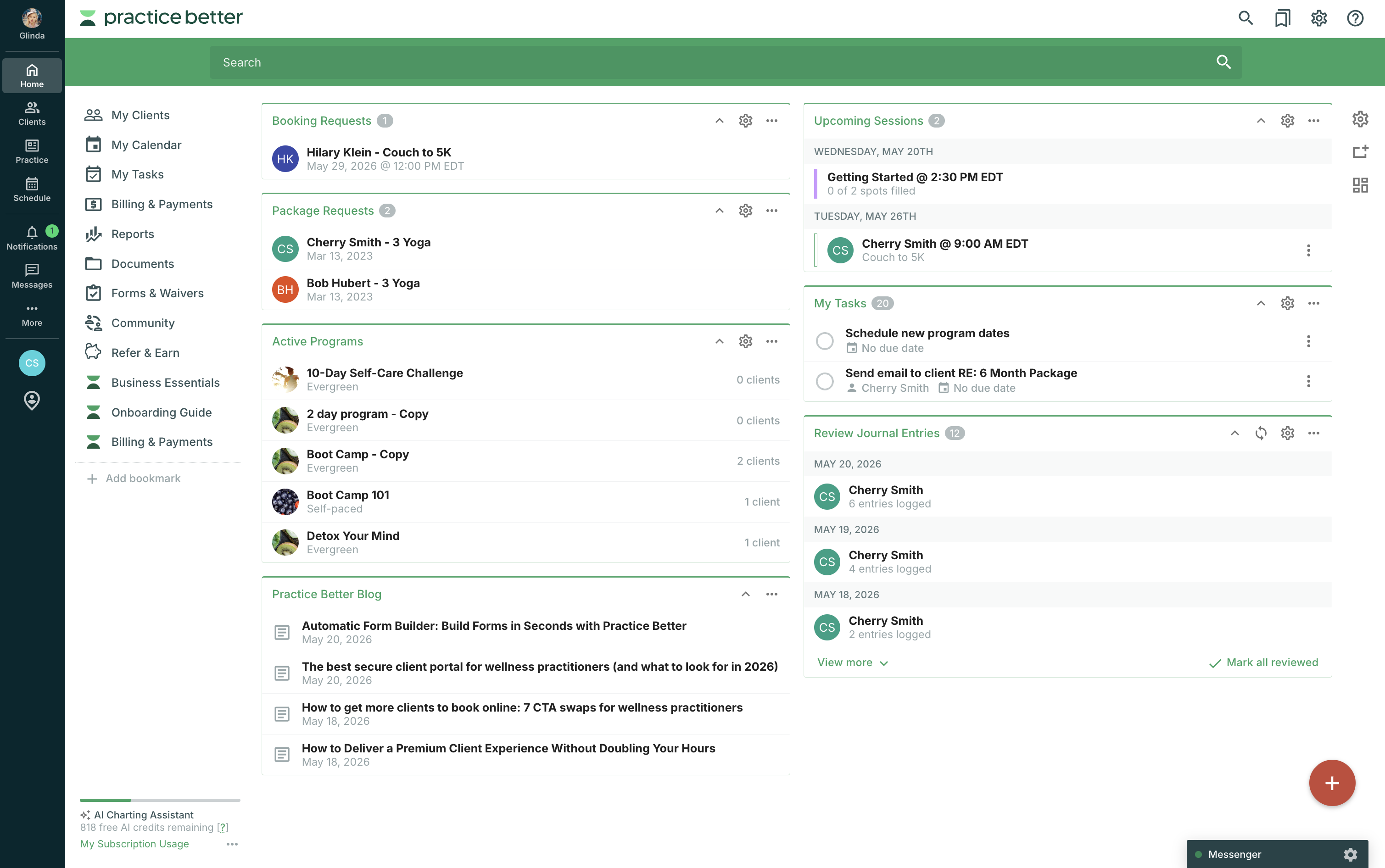
For wellness practitioners — dietitians, health coaches, functional medicine practitioners, naturopathic doctors — a client portal is the infrastructure for the entire client relationship outside the session.
That means secure communication, intake and consent, self-scheduling, program and resource delivery, between-session tracking (food, habits, symptoms, biometrics), and billing. All of it, without the client navigating five different apps or texting you when something breaks.
The HIPAA standard applies here because the data moving through that portal — health history, session notes, food logs, lab results — is protected health information. A portal that carries PHI needs comprehensive compliance coverage, including a signed BAA, regardless of what the marketing page says.
Most EHR and practice management portals were designed for medicine: the patient shows up, sees the doctor, leaves. The portal exists to book the next appointment and view a visit summary.
Wellness care runs on a different model. Your clients are tracking food between sessions, logging symptoms daily, following a protocol that spans six weeks. A portal that goes quiet the moment an appointment ends leaves the most valuable real estate in the client relationship unused.
"HIPAA-compliant" appears in almost every platform's marketing copy. What it means varies significantly. Some platforms offer HIPAA compliance at the infrastructure level but require a Business Associate Agreement only on higher-tier plans. Others encrypt data in transit but not at rest. For wellness practitioners handling sensitive dietary, mental health, or lab data, compliance needs to be comprehensive and covered by a signed BAA — included on every plan, regardless of pricing tier.
Fragmentation is the quiet driver of client disengagement. When paying an invoice means navigating a separate payment link, food tracking means opening a third-party app, and messaging means texting your personal number, the portal has stopped functioning as a portal. Every extra step compounds into friction, and friction compounds into dropout.
A well-built client portal supports what the client is working on between sessions: the food journal entry from Tuesday, the habit they logged Wednesday morning, the question they had at 10pm Thursday. Practitioners with access to that data arrive to every session already informed. A portal that only stores appointment summaries means starting from scratch every time.
Your clients chose to work with you. A portal that presents a generic health dashboard, omits your name and logo, and sends automated emails from a no-reply platform address creates a brand experience mismatch from day one. The portal should feel like an extension of your practice.
{{free-trial-simple-text}}
When evaluating client portal options, three areas separate purpose-built tools from general-purpose solutions.
Look for a signed BAA included on your plan, end-to-end encryption for messaging and file sharing, and clear documentation of where data is stored and how it's protected. Pull the compliance page directly — the homepage badge alone isn't sufficient.
Look for food and habit logging, progress tracking across weight, labs, biometrics, and symptoms, wearable integrations (Apple Health, Fitbit, Garmin, Oura), and a way for clients to log entries and receive feedback outside of appointment windows.
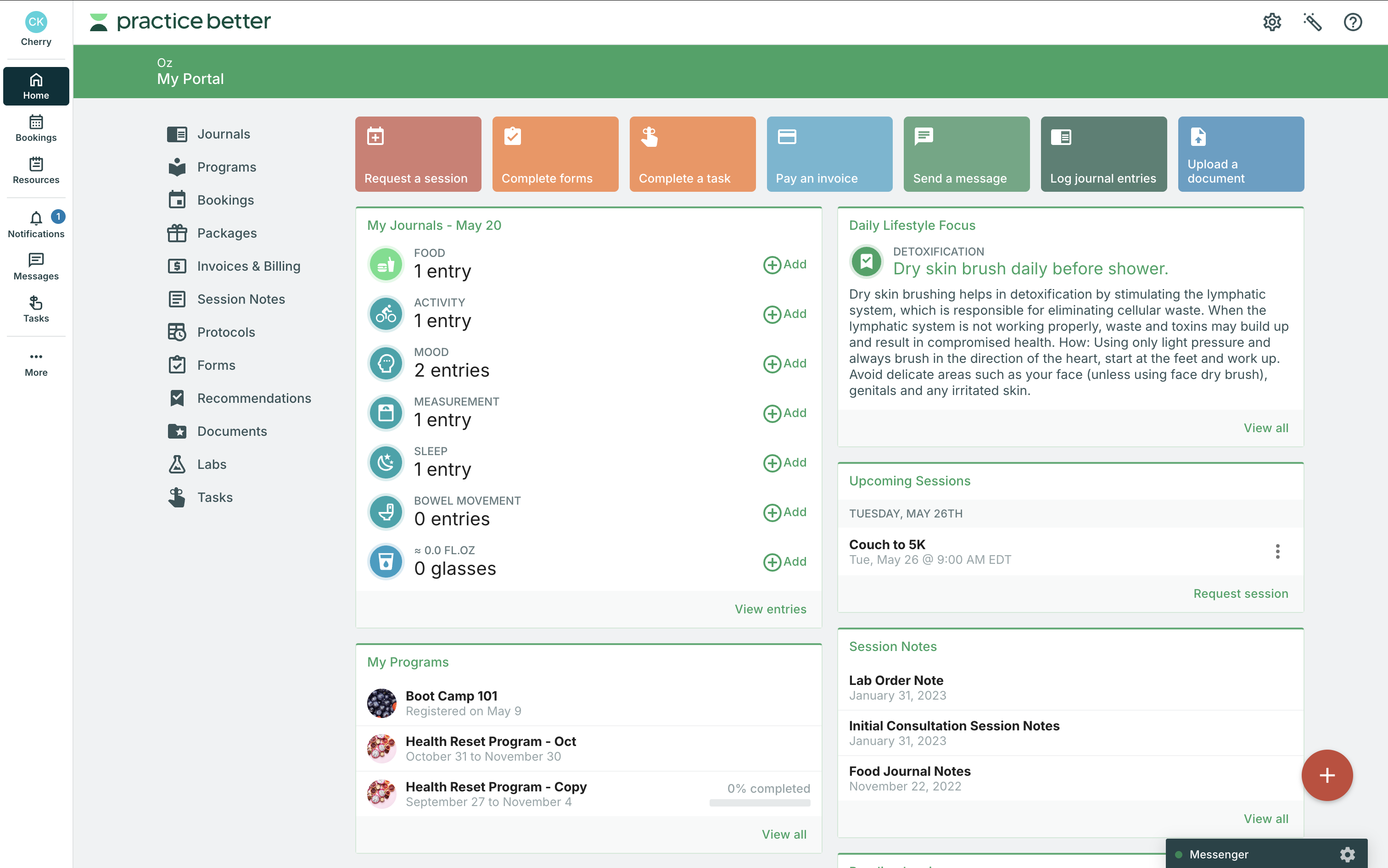
Intake forms, consent waivers, scheduling, messaging, resource access, program delivery, food tracking, and billing should all exist within the same authenticated session. A client who has to navigate outside the portal to complete a routine task signals a gap in the platform.
Practice Better's client portal is built around continuous care — the idea that the client relationship runs between sessions, not just during them.
Scheduling and intake: Clients book, reschedule, and cancel directly. Intake forms and consent waivers are completed inside the portal before the first session.
HIPAA-compliant messaging: All client communication runs through a single encrypted thread. No personal phone, no email chain, no DMs.
Between-session tracking: Clients log food from a database of 600,000+ items, track habits and symptoms, and connect wearables — Apple Health, Fitbit, Garmin Connect, and Oura — so their data arrives in your dashboard in real time.
Programs and protocols: Care plans, resources, courses, and handouts live in the portal and stay accessible any time. Clients find what they need without emailing you for it.
Billing: Clients view invoices and pay inside the portal. No separate payment link, no third-party redirect.
For context: platforms like SimplePractice offer strong client portals optimized for mental health and behavioral care. Practice Fusion is a physician EHR built around clinical documentation and medical billing workflows — the client relationship infrastructure wellness practitioners need isn't what it's designed for. On the enterprise end, systems like Epic and athenahealth serve hospital networks and large health systems where the "portal" is one component of a massive clinical infrastructure, not the center of the practitioner-client relationship. Practice Better is built for practitioners whose work depends on between-session continuity: dietitians, health coaches, functional medicine providers, and therapists working at the intersection of mental and physical health.
Practice Better is rated 4.7/5 on G2, with practitioners consistently citing the integrated portal as a core reason they stay.
Read the reviews → https://www.g2.com/products/practice-better/reviews
A secure client portal for wellness practitioners handles the full scope of the client relationship: intake, communication, tracking, program delivery, and billing — all inside a single HIPAA-compliant session. The measure of a portal is whether clients can do everything they need between sessions without leaving it, and whether practitioners arrive to each session with a complete picture of what happened since the last one.
{{free-trial-simple-text}}
.jpg)
Your client portal is the first thing a new client sees when they say yes to working with you. It's also what they come back to between every session — to log their food, read their care plan, message you, pay their invoice, and check in on their habits. If that experience is scattered, confusing, or just a login page with an appointment list, you're losing engagement you worked hard to earn.
TL;DR
See how Practice Better's client portal works.
For wellness practitioners — dietitians, health coaches, functional medicine practitioners, naturopathic doctors — a client portal is the infrastructure for the entire client relationship outside the session.
That means secure communication, intake and consent, self-scheduling, program and resource delivery, between-session tracking (food, habits, symptoms, biometrics), and billing. All of it, without the client navigating five different apps or texting you when something breaks.
The HIPAA standard applies here because the data moving through that portal — health history, session notes, food logs, lab results — is protected health information. A portal that carries PHI needs comprehensive compliance coverage, including a signed BAA, regardless of what the marketing page says.
Most EHR and practice management portals were designed for medicine: the patient shows up, sees the doctor, leaves. The portal exists to book the next appointment and view a visit summary.
Wellness care runs on a different model. Your clients are tracking food between sessions, logging symptoms daily, following a protocol that spans six weeks. A portal that goes quiet the moment an appointment ends leaves the most valuable real estate in the client relationship unused.
"HIPAA-compliant" appears in almost every platform's marketing copy. What it means varies significantly. Some platforms offer HIPAA compliance at the infrastructure level but require a Business Associate Agreement only on higher-tier plans. Others encrypt data in transit but not at rest. For wellness practitioners handling sensitive dietary, mental health, or lab data, compliance needs to be comprehensive and covered by a signed BAA — included on every plan, regardless of pricing tier.
Fragmentation is the quiet driver of client disengagement. When paying an invoice means navigating a separate payment link, food tracking means opening a third-party app, and messaging means texting your personal number, the portal has stopped functioning as a portal. Every extra step compounds into friction, and friction compounds into dropout.
A well-built client portal supports what the client is working on between sessions: the food journal entry from Tuesday, the habit they logged Wednesday morning, the question they had at 10pm Thursday. Practitioners with access to that data arrive to every session already informed. A portal that only stores appointment summaries means starting from scratch every time.
Your clients chose to work with you. A portal that presents a generic health dashboard, omits your name and logo, and sends automated emails from a no-reply platform address creates a brand experience mismatch from day one. The portal should feel like an extension of your practice.
{{free-trial-simple-text}}
When evaluating client portal options, three areas separate purpose-built tools from general-purpose solutions.
Look for a signed BAA included on your plan, end-to-end encryption for messaging and file sharing, and clear documentation of where data is stored and how it's protected. Pull the compliance page directly — the homepage badge alone isn't sufficient.
Look for food and habit logging, progress tracking across weight, labs, biometrics, and symptoms, wearable integrations (Apple Health, Fitbit, Garmin, Oura), and a way for clients to log entries and receive feedback outside of appointment windows.
Intake forms, consent waivers, scheduling, messaging, resource access, program delivery, food tracking, and billing should all exist within the same authenticated session. A client who has to navigate outside the portal to complete a routine task signals a gap in the platform.
Practice Better's client portal is built around continuous care — the idea that the client relationship runs between sessions, not just during them.
Scheduling and intake: Clients book, reschedule, and cancel directly. Intake forms and consent waivers are completed inside the portal before the first session.
HIPAA-compliant messaging: All client communication runs through a single encrypted thread. No personal phone, no email chain, no DMs.
Between-session tracking: Clients log food from a database of 600,000+ items, track habits and symptoms, and connect wearables — Apple Health, Fitbit, Garmin Connect, and Oura — so their data arrives in your dashboard in real time.
Programs and protocols: Care plans, resources, courses, and handouts live in the portal and stay accessible any time. Clients find what they need without emailing you for it.
Billing: Clients view invoices and pay inside the portal. No separate payment link, no third-party redirect.
For context: platforms like SimplePractice offer strong client portals optimized for mental health and behavioral care. Practice Fusion is a physician EHR built around clinical documentation and medical billing workflows — the client relationship infrastructure wellness practitioners need isn't what it's designed for. On the enterprise end, systems like Epic and athenahealth serve hospital networks and large health systems where the "portal" is one component of a massive clinical infrastructure, not the center of the practitioner-client relationship. Practice Better is built for practitioners whose work depends on between-session continuity: dietitians, health coaches, functional medicine providers, and therapists working at the intersection of mental and physical health.
Practice Better is rated 4.7/5 on G2, with practitioners consistently citing the integrated portal as a core reason they stay.
Read the reviews → https://www.g2.com/products/practice-better/reviews
A secure client portal for wellness practitioners handles the full scope of the client relationship: intake, communication, tracking, program delivery, and billing — all inside a single HIPAA-compliant session. The measure of a portal is whether clients can do everything they need between sessions without leaving it, and whether practitioners arrive to each session with a complete picture of what happened since the last one.
{{free-trial-simple-text}}



%202.png)