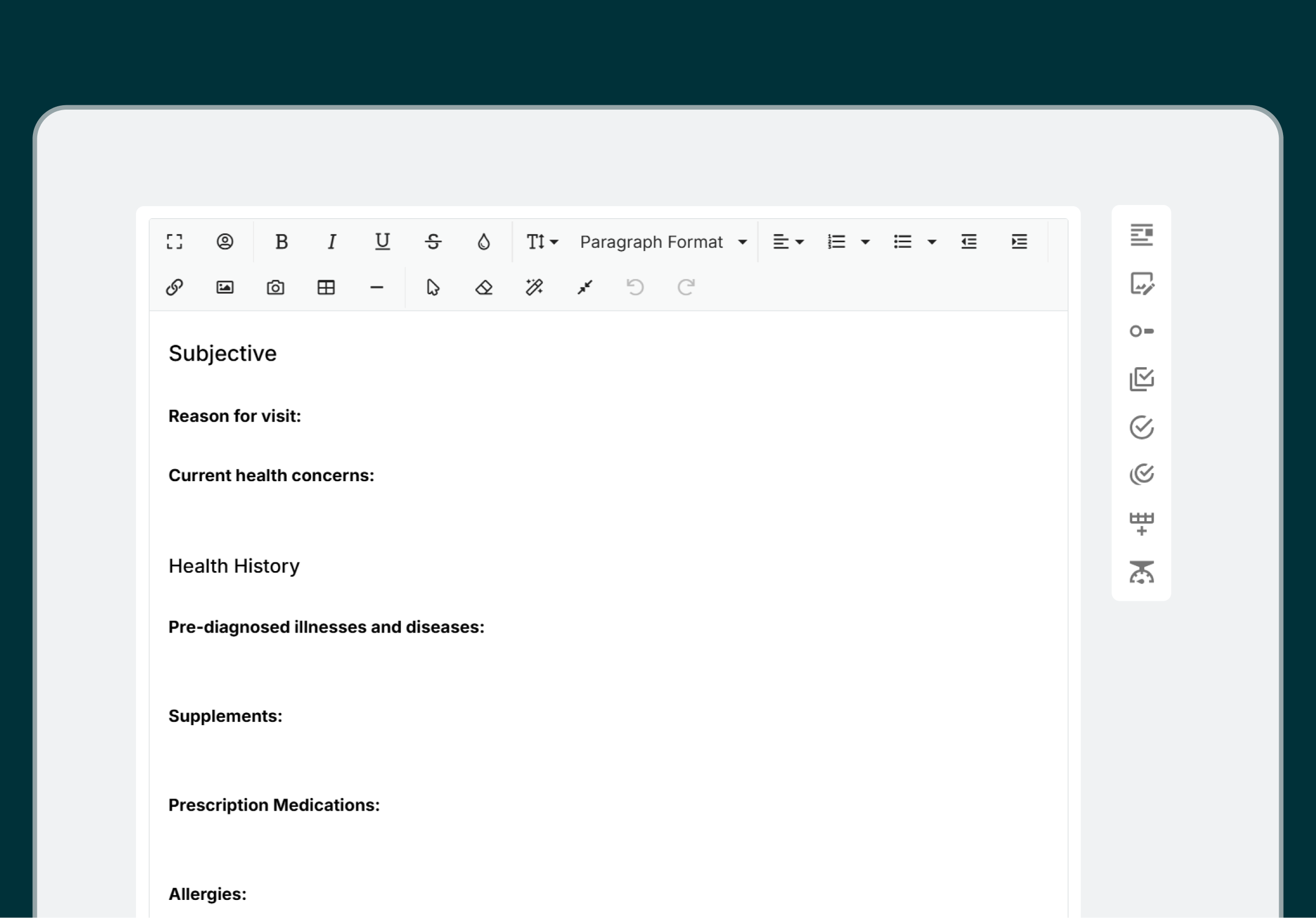
A care plan template is a reusable layout for the written plan a client takes home after an assessment: what they want to change, the goals you agreed on, the actions that get them there, and when you will review progress. Practice Better's guide to formatting protocols describes this document as the action plan you create after a consultation to guide a client toward their health goals (6 ways to format protocols). In Medicare's chronic care guidance, a comprehensive care plan is patient-centered and built on an assessment that spans physical, mental, cognitive, psychosocial, functional, and environmental needs (CMS, Chronic Care Management Services, MLN909188).
This guide is for private practices in functional medicine, naturopathy, nutrition, and health coaching. It gives you a template to copy, three worked examples, and the steps to write and review a plan. If you work in home care or are writing a nursing care plan for a course, use the format your agency or program sets.
Skip to the care plan template you can copy.
Every example here is illustrative. The clients are composites written to show the format, and none is a real person or record. No example states a dose, a lab value, or a diagnosis.
A care plan for a wellness practice carries eight sections: who and when, the reason for care, goals, actions, resources, tracking, obstacles, and review. The first five describe the plan. The last three keep it alive between visits.
The clinical reference point is the CMS list for comprehensive care plans, written as Medicare guidance for physicians and other practitioners who bill chronic care management and borrowed here for its structure. It includes a problem list, expected outcome and prognosis, measurable treatment goals, symptom management, planned interventions, coordination with outside resources and practitioners, and periodic review (CMS, MLN909188). The template below translates that list into sections a functional medicine, nutrition, or coaching client can read and act on.
| Section | What goes there | Why it earns its place |
|---|---|---|
| Header (who and when) | Client name, practitioner, date, plan version, next review date | Tells anyone reading which plan is current |
| Reason for care | What the client wants help with, in their words, plus your assessment summary | Keeps the plan tied to the client's own priorities |
| Goals | A small number of goals, each specific and measurable with a time frame | Gives you and the client something to check at review |
| Actions | Each recommendation written as what, why, and how | The part the client follows day to day |
| Resources | Handouts, meal plans, videos, and supplement instructions the plan refers to | Puts everything the plan mentions in one place |
| Tracking | What the client logs between visits and where | Gives you evidence at the review |
| Obstacles | What the client does when a week goes off track | Keeps one bad week from ending the plan |
| Review and care team | Review date, what you will measure, and any other practitioners involved | Sets the next checkpoint and records who else is involved |
The goals row follows the SMART framework, which stands for specific, measurable, attainable, realistic, and time-bound (your guide to setting realistic goals with clients). The actions row follows Practice Better's protocol standard of clear recommendations on what to do, why, and how (Protocols).
Copy the block below into your notes, a document, or your practice software, and fill the brackets for each client.
CARE PLAN
1. WHO AND WHEN
Client: [name] Practitioner: [name, credentials]
Date: [date] Plan version: [1, 2, 3...]
Next review: [date]
2. REASON FOR CARE
In the client's words: [what they want help with]
Assessment summary: [your findings from intake and the session]
3. GOALS
Goal 1: [specific, measurable, time-bound]
Goal 2: [specific, measurable, time-bound]
Why these matter to the client: [their reason, in their words]
4. ACTIONS (what / why / how)
Food: [what] / [why] / [how]
Supplements: [name, dose, timing as you prescribe] / [why] / [how to take]
Lifestyle: [what] / [why] / [how]
Testing or referrals: [test or referral, timing]
5. RESOURCES
[handout, meal plan, video, recipe, supplement chart]
6. TRACKING
Client logs: [what, which days, where]
Practitioner checks: [what you will look at before review]
7. IF A WEEK GOES OFF TRACK
[the smallest version of the plan the client can still do]
[how to reach you]
8. REVIEW AND CARE TEAM
At review we will look at: [measures]
Other practitioners involved: [name, role, what they handle]
Two fields do more work than they look. The plan version number tells you and the client which plan is current once you start revising. The "if a week goes off track" field puts in writing what Practice Better's protocol guide calls anticipating obstacles: setting expectations and an action plan for the weeks when circumstances get in the way (6 ways to format protocols).
Each example shows the composite scenario and the plan as the client would see it. Clinical choices appear as bracketed fields, because they belong to the practitioner writing the plan.
Composite scenario: an adult client with low energy and digestive complaints, plan written after the intake review and first visit.
Reason for care, in the client's words: "I want enough energy to walk with my kids after work, and I want my stomach to stop running my day."
Goals:
Actions:
Tracking: daily energy rating, digestive symptoms, and sleep in the client's journal.
Review: booked before the client leaves the first visit. At review, compare the energy ratings and symptom log against the first week.
Give the supplement line its own chart. A dedicated chart with name, dose, and timing, attached to the plan, gives the client one place to check.
Composite scenario: a client working with a dietitian on meal planning around a busy work schedule, second visit.
Reason for care, in the client's words: "I skip lunch, then eat whatever is in the house at nine at night."
Goals:
Actions:
Resources: a seven-day meal plan with recipes, a grocery list, and a short handout on packing lunches.
Tracking: food journal entries for lunch and dinner, photos welcome.
Review: compare the journal with the meal plan and adjust the recipes the client skipped.
Notice the client's own phrasing in the reason for care. When the review comes, the first question writes itself: is the nine o'clock pattern still there?
Composite scenario: a client working with a health coach on movement and stress, third session.
Reason for care, in the client's words: "I want to stop feeling wired at bedtime."
Goals:
Actions:
Obstacles: on a day the full walk gets missed, a five-minute walk around the block still counts.
Tracking: a daily habit check-in for the walk and the screen-off time.
Review: look at the habit log together and pick which goal to raise.
A coaching plan stays with habits and behaviors the client chose. If a client's goals start to need a clinical plan, the care team section is where you record the referral and who now holds that part of the plan.
You write a care plan in seven steps: start from the assessment, agree the goals, write each action as what, why, and how, start with small wins, attach resources and plan for obstacles, set the review and share the plan, then revise and keep versions.
The session note and the care plan do different jobs. The note records what happened in the session and your reasoning. The plan tells the client what to do next. If you chart in SOAP, the plan section of each note is where you record what changed in the care plan; how to write a SOAP note covers the format.
You build a care plan in Practice Better with its protocol and care plan builder, which lets you create reusable care plans with tasks, resources, timelines, and automated drip delivery (Practice Better vs. Zanda Health). You can save individual food, supplement, and lifestyle recommendations and turn them into protocol templates you customize for each client (Protocols).
Here is how each section of the template maps onto the platform:
| Template section | Where it lives in Practice Better | Source |
|---|---|---|
| Actions | Protocols with food, supplement, and lifestyle recommendations, plus a client-friendly supplement chart and online dispensary integrations | Protocols |
| Resources | Protocols can hold meal plans, PDF resources, supplement recommendations, and video content in one place | 6 ways to format protocols |
| Tracking | Food and lifestyle journals with daily nutrient and lifestyle targets, mood, and measurements | Journaling |
| Review | Note templates where every note includes required fields for assessment, plan, and follow-up | Templates |
| Session record | Protocols, labs, and tasks attached directly to session notes, with notes kept alongside the client's care plan, programs, and intake history | Charting |
| Ongoing education | Evergreen programs whose modules unlock based on each client's enrollment date | Evergreen programs |
The client side matters as much as the build. In Practice Better, care plans, resources, courses, and handouts live in the client portal and stay accessible any time (best secure client portal for wellness practitioners). Lactation consultant Trine Bradshaw describes writing the care plan with clients in her office, going through it in person, and then having them open it in the Better App before they leave (client communication with Trine Bradshaw).
{{general-template-library-simple-text}}
The CMS guidance on chronic care management lists the elements a comprehensive care plan can include, from a problem list and measurable treatment goals to planned interventions and periodic review (CMS, MLN909188). For a wellness practice, the template above uses eight sections: who and when, the reason for care, goals, actions, resources, tracking, obstacles, and review.
Practice Better describes the action plan you create after a consultation as a protocol: the recommendations that guide a client toward their health goals (6 ways to format protocols). A care plan holds those recommendations plus the goals, tracking, and review schedule around them. Practice Better names its tool for this the protocol and care plan builder (Practice Better vs. Zanda Health).
You can use one layout for every client and change the content for each one. Practice Better's protocol templates are built to be customized and reused (Protocols), and its guide to formatting protocols says every protocol should reflect the needs of that particular client (6 ways to format protocols).
CMS guidance for chronic care management says to give patients and caregivers a copy of the care plan when necessary (CMS, MLN909188). In a wellness practice, the client follows the plan between visits, so share a version they can open at home.
Practice Better's protocol and care plan builder lets you create reusable care plans with tasks, resources, timelines, and automated drip delivery (Practice Better vs. Zanda Health). You can save food, supplement, and lifestyle recommendations (Protocols), attach protocols, labs, and tasks to session notes (Charting), and clients find their care plans in the client portal (best secure client portal).
Copy the template above, fill the brackets for your next new client, and book the review before they leave. Then keep the plan, the session notes, and the client's tracking in one record.
Start a free trial of Practice Better to build reusable care plans and share them with clients in the portal.
{{free-trial-simple-text}}

A care plan template is a reusable layout for the written plan a client takes home after an assessment: what they want to change, the goals you agreed on, the actions that get them there, and when you will review progress. Practice Better's guide to formatting protocols describes this document as the action plan you create after a consultation to guide a client toward their health goals (6 ways to format protocols). In Medicare's chronic care guidance, a comprehensive care plan is patient-centered and built on an assessment that spans physical, mental, cognitive, psychosocial, functional, and environmental needs (CMS, Chronic Care Management Services, MLN909188).
This guide is for private practices in functional medicine, naturopathy, nutrition, and health coaching. It gives you a template to copy, three worked examples, and the steps to write and review a plan. If you work in home care or are writing a nursing care plan for a course, use the format your agency or program sets.
Skip to the care plan template you can copy.
Every example here is illustrative. The clients are composites written to show the format, and none is a real person or record. No example states a dose, a lab value, or a diagnosis.
A care plan for a wellness practice carries eight sections: who and when, the reason for care, goals, actions, resources, tracking, obstacles, and review. The first five describe the plan. The last three keep it alive between visits.
The clinical reference point is the CMS list for comprehensive care plans, written as Medicare guidance for physicians and other practitioners who bill chronic care management and borrowed here for its structure. It includes a problem list, expected outcome and prognosis, measurable treatment goals, symptom management, planned interventions, coordination with outside resources and practitioners, and periodic review (CMS, MLN909188). The template below translates that list into sections a functional medicine, nutrition, or coaching client can read and act on.
| Section | What goes there | Why it earns its place |
|---|---|---|
| Header (who and when) | Client name, practitioner, date, plan version, next review date | Tells anyone reading which plan is current |
| Reason for care | What the client wants help with, in their words, plus your assessment summary | Keeps the plan tied to the client's own priorities |
| Goals | A small number of goals, each specific and measurable with a time frame | Gives you and the client something to check at review |
| Actions | Each recommendation written as what, why, and how | The part the client follows day to day |
| Resources | Handouts, meal plans, videos, and supplement instructions the plan refers to | Puts everything the plan mentions in one place |
| Tracking | What the client logs between visits and where | Gives you evidence at the review |
| Obstacles | What the client does when a week goes off track | Keeps one bad week from ending the plan |
| Review and care team | Review date, what you will measure, and any other practitioners involved | Sets the next checkpoint and records who else is involved |
The goals row follows the SMART framework, which stands for specific, measurable, attainable, realistic, and time-bound (your guide to setting realistic goals with clients). The actions row follows Practice Better's protocol standard of clear recommendations on what to do, why, and how (Protocols).
Copy the block below into your notes, a document, or your practice software, and fill the brackets for each client.
CARE PLAN
1. WHO AND WHEN
Client: [name] Practitioner: [name, credentials]
Date: [date] Plan version: [1, 2, 3...]
Next review: [date]
2. REASON FOR CARE
In the client's words: [what they want help with]
Assessment summary: [your findings from intake and the session]
3. GOALS
Goal 1: [specific, measurable, time-bound]
Goal 2: [specific, measurable, time-bound]
Why these matter to the client: [their reason, in their words]
4. ACTIONS (what / why / how)
Food: [what] / [why] / [how]
Supplements: [name, dose, timing as you prescribe] / [why] / [how to take]
Lifestyle: [what] / [why] / [how]
Testing or referrals: [test or referral, timing]
5. RESOURCES
[handout, meal plan, video, recipe, supplement chart]
6. TRACKING
Client logs: [what, which days, where]
Practitioner checks: [what you will look at before review]
7. IF A WEEK GOES OFF TRACK
[the smallest version of the plan the client can still do]
[how to reach you]
8. REVIEW AND CARE TEAM
At review we will look at: [measures]
Other practitioners involved: [name, role, what they handle]
Two fields do more work than they look. The plan version number tells you and the client which plan is current once you start revising. The "if a week goes off track" field puts in writing what Practice Better's protocol guide calls anticipating obstacles: setting expectations and an action plan for the weeks when circumstances get in the way (6 ways to format protocols).
Each example shows the composite scenario and the plan as the client would see it. Clinical choices appear as bracketed fields, because they belong to the practitioner writing the plan.
Composite scenario: an adult client with low energy and digestive complaints, plan written after the intake review and first visit.
Reason for care, in the client's words: "I want enough energy to walk with my kids after work, and I want my stomach to stop running my day."
Goals:
Actions:
Tracking: daily energy rating, digestive symptoms, and sleep in the client's journal.
Review: booked before the client leaves the first visit. At review, compare the energy ratings and symptom log against the first week.
Give the supplement line its own chart. A dedicated chart with name, dose, and timing, attached to the plan, gives the client one place to check.
Composite scenario: a client working with a dietitian on meal planning around a busy work schedule, second visit.
Reason for care, in the client's words: "I skip lunch, then eat whatever is in the house at nine at night."
Goals:
Actions:
Resources: a seven-day meal plan with recipes, a grocery list, and a short handout on packing lunches.
Tracking: food journal entries for lunch and dinner, photos welcome.
Review: compare the journal with the meal plan and adjust the recipes the client skipped.
Notice the client's own phrasing in the reason for care. When the review comes, the first question writes itself: is the nine o'clock pattern still there?
Composite scenario: a client working with a health coach on movement and stress, third session.
Reason for care, in the client's words: "I want to stop feeling wired at bedtime."
Goals:
Actions:
Obstacles: on a day the full walk gets missed, a five-minute walk around the block still counts.
Tracking: a daily habit check-in for the walk and the screen-off time.
Review: look at the habit log together and pick which goal to raise.
A coaching plan stays with habits and behaviors the client chose. If a client's goals start to need a clinical plan, the care team section is where you record the referral and who now holds that part of the plan.
You write a care plan in seven steps: start from the assessment, agree the goals, write each action as what, why, and how, start with small wins, attach resources and plan for obstacles, set the review and share the plan, then revise and keep versions.
The session note and the care plan do different jobs. The note records what happened in the session and your reasoning. The plan tells the client what to do next. If you chart in SOAP, the plan section of each note is where you record what changed in the care plan; how to write a SOAP note covers the format.
You build a care plan in Practice Better with its protocol and care plan builder, which lets you create reusable care plans with tasks, resources, timelines, and automated drip delivery (Practice Better vs. Zanda Health). You can save individual food, supplement, and lifestyle recommendations and turn them into protocol templates you customize for each client (Protocols).
Here is how each section of the template maps onto the platform:
| Template section | Where it lives in Practice Better | Source |
|---|---|---|
| Actions | Protocols with food, supplement, and lifestyle recommendations, plus a client-friendly supplement chart and online dispensary integrations | Protocols |
| Resources | Protocols can hold meal plans, PDF resources, supplement recommendations, and video content in one place | 6 ways to format protocols |
| Tracking | Food and lifestyle journals with daily nutrient and lifestyle targets, mood, and measurements | Journaling |
| Review | Note templates where every note includes required fields for assessment, plan, and follow-up | Templates |
| Session record | Protocols, labs, and tasks attached directly to session notes, with notes kept alongside the client's care plan, programs, and intake history | Charting |
| Ongoing education | Evergreen programs whose modules unlock based on each client's enrollment date | Evergreen programs |
The client side matters as much as the build. In Practice Better, care plans, resources, courses, and handouts live in the client portal and stay accessible any time (best secure client portal for wellness practitioners). Lactation consultant Trine Bradshaw describes writing the care plan with clients in her office, going through it in person, and then having them open it in the Better App before they leave (client communication with Trine Bradshaw).
{{general-template-library-simple-text}}
The CMS guidance on chronic care management lists the elements a comprehensive care plan can include, from a problem list and measurable treatment goals to planned interventions and periodic review (CMS, MLN909188). For a wellness practice, the template above uses eight sections: who and when, the reason for care, goals, actions, resources, tracking, obstacles, and review.
Practice Better describes the action plan you create after a consultation as a protocol: the recommendations that guide a client toward their health goals (6 ways to format protocols). A care plan holds those recommendations plus the goals, tracking, and review schedule around them. Practice Better names its tool for this the protocol and care plan builder (Practice Better vs. Zanda Health).
You can use one layout for every client and change the content for each one. Practice Better's protocol templates are built to be customized and reused (Protocols), and its guide to formatting protocols says every protocol should reflect the needs of that particular client (6 ways to format protocols).
CMS guidance for chronic care management says to give patients and caregivers a copy of the care plan when necessary (CMS, MLN909188). In a wellness practice, the client follows the plan between visits, so share a version they can open at home.
Practice Better's protocol and care plan builder lets you create reusable care plans with tasks, resources, timelines, and automated drip delivery (Practice Better vs. Zanda Health). You can save food, supplement, and lifestyle recommendations (Protocols), attach protocols, labs, and tasks to session notes (Charting), and clients find their care plans in the client portal (best secure client portal).
Copy the template above, fill the brackets for your next new client, and book the review before they leave. Then keep the plan, the session notes, and the client's tracking in one record.
Start a free trial of Practice Better to build reusable care plans and share them with clients in the portal.
{{free-trial-simple-text}}