PIE notes are clinical notes written in three sections: Problem, Intervention, and Evaluation. The OpenStax Fundamentals of Nursing textbook defines the PIE method as a form of problem-oriented documentation, the same family SOAP belongs to. Each note names the client's problem, records what you did about it, and describes how the client responded (OpenStax, section 14.5).
Below you will find a blank PIE template, a step-by-step method for writing each section, and six worked examples for a dietitian, a health coach, a functional medicine practitioner, and a counselor. Two of the examples are follow-up notes, so you can see the evaluation section close the loop on an earlier session.
Every example here is illustrative. The clients are composites written to demonstrate the format, and none is a real person or a real record.
Each section answers one question, and the three together give a reader the problem, the action, and the result.
| Section | The question it answers | What belongs there |
|---|---|---|
| Problem | What are we working on? | The issue in one or two sentences, with the evidence: the client's words, what you observed, or what their log shows |
| Intervention | What did you do about it? | The actions you took this session: education, a skill practiced, a resource sent, a task assigned |
| Evaluation | How did the client respond? | The client's response to each intervention, and what you will check next time |
OpenStax describes the three parts this way: the problem is what you identify, the intervention is the action taken to address it, and the evaluation is the client's response to that action (OpenStax, section 14.5). The same source names the trade-off. PIE keeps a direct line between each problem and the care provided, and its focus on ongoing evaluation helps when you adapt the care plan, but the level of detail it asks for takes time.
PIE has three sections where SOAP has four. With no separate section for objective data, the evidence for a problem goes into the problem statement itself. If you skip that, the problem reads as an opinion with nothing behind it.
Copy this into your notes system and fill it in during or right after the session. When a session covers a second problem, repeat the block and number it.
PIE NOTE
Client: Date: Session type:
P1 Problem
- Issue, in one or two sentences:
- Evidence (client's words, observation, log or tracker data):
I1 Intervention
- What you did this session (taught, practiced, assigned, sent):
- Detail a colleague would need to repeat it:
E1 Evaluation
- Client's response to each intervention, in session:
- What you will check next time, and when:
(Repeat P2 / I2 / E2 for each additional problem)
Numbering the blocks keeps each evaluation tied to its own problem when one session covers two.
Write the three sections in order, keep each one to its own job, and end with what you will check next time. The four steps below are the full method.
Write the problem in one or two sentences and put the evidence beside it. "Client reports skipping breakfast on workdays" is a problem. "Client is struggling with eating" is a label that the next reader has to decode.
List what you did as specific actions. "Discussed breakfast" leaves a colleague guessing what happened. "Built three workday breakfast options with the client and sent the handout through the client portal" tells them exactly what happened.
Describe how the client responded, using what they said and did. "Tolerated session well" leaves the reader guessing whether the plan landed. "Client chose two of the three options and said the third needs a fridge at work" shows the client engaged with the plan and names the barrier.
Close the evaluation with what you will look at next session and when. That line is what the next note evaluates against, which is how PIE notes build a running record of each problem across visits.
Here are six. The first two follow one dietitian client across two sessions, the last two follow one counseling client the same way, and the functional medicine example shows a note covering two problems.
Composite scenario: initial nutrition session, client wants steadier energy at work.
P: Client reports skipping breakfast on workdays and feeling hungry by mid-morning, then buying snacks from the office vending machine. Eats breakfast on weekends without difficulty. Says mornings are rushed because of school drop-off.
I: Walked through the client's workday morning routine to find where breakfast could fit. Built three grab-and-go breakfast options with the client, each one ready in under five minutes. Sent a breakfast ideas handout through the client portal. Asked the client to log breakfast in the food journal on workdays until the next session.
E: Client chose two of the three options as realistic and said the third needs a fridge at work, which they do not have. Client restated the plan in their own words. Review the food journal at the next session in two weeks, looking at how many workdays include a logged breakfast.
Composite scenario: two weeks later, same client.
P: Continuing: workday breakfast. Food journal shows breakfast logged on seven of ten workdays. Client reports fewer vending machine trips and says the overnight oats option is the one that stuck.
I: Reviewed the food journal with the client. Identified that the three missed days were all Mondays. Planned a Sunday evening prep step for Monday's breakfast. Added a protein-focused variation of the overnight oats at the client's request and sent the recipe through the portal.
E: Client described the change as easier than expected and said Mondays are the remaining gap. Agreed to the Sunday prep step. Check Monday entries specifically at the next session in three weeks.
The follow-up evaluation answers the question the first note asked. Without that line in the first note, the second has nothing to measure against.
Composite scenario: week four of a coaching program, client's goal is daily movement.
P: Client set a goal of a 20-minute walk after dinner and has done it twice in the past two weeks, per their habit tracker. Says evenings are taken up by their children's activities.
I: Explored where in the day the client has a predictable gap. Client identified the lunch break. Moved the walk to lunch on three named weekdays and set a calendar reminder together during the session. Kept the evening walk as an optional weekend activity.
E: Client described the lunch plan as easier to keep than the evening one and named a walking route near the office. Review the habit tracker at the next check-in in one week, counting lunch walks completed against the three planned.
Composite scenario: second visit, digestive complaints and afternoon fatigue. Lab work ordered at the first visit is still pending.
P1: Client reports bloating after meals on five of seven days in the symptom log, worse in the evening. No pattern yet between specific foods and symptoms.
I1: Reviewed the symptom log with the client. Added meal timing and a short food description to each log entry so food and symptom can be matched. Asked the client to keep their current diet unchanged until lab results are reviewed, so any change in symptoms can be read against a stable baseline.
E1: Client agreed to hold diet changes and said the extra log fields are manageable. Review the expanded log alongside lab results at the next visit.
P2: Client reports an energy dip in the mid-afternoon on workdays, managed with a second coffee. Sleep log shows bedtimes varying by up to two hours across the week.
I2: Shared the sleep log pattern with the client. Agreed on a fixed weeknight bedtime, chosen by the client, as a first step. Added a bedtime field to the existing tracker so sleep and energy sit in one log.
E2: Client chose the bedtime and said weekends would be harder to hold. Review the tracker for bedtime consistency and afternoon energy at the next visit, alongside P1.
Numbering lets each evaluation answer its own problem, and the next visit can review P1 and P2 separately.
Composite scenario: session five, client working on work-related worry.
P: Client reports lying awake on weeknights thinking about work email they have not opened. Avoids checking email after 6pm, then worries about what it contains. Describes Sunday evenings as the worst.
I: Gave psychoeducation on how avoidance can keep worry going. Practiced a written worry list in session: client wrote down each work concern and one next step for it. Assigned a 15-minute worry-writing window before dinner on weeknights, with the list kept on paper away from the bedroom.
E: Client completed the worry list in session and said writing it down felt lighter. Expressed doubt about doing it at home on busy evenings. Review the worry list and the client's report of weeknight sleep at the next session in one week.
Composite scenario: session six, same client.
P: Continuing: weeknight worry about work. Client completed the worry-writing window on three of five weeknights. Reports falling asleep faster on those nights by their own account. Missed both days that ran late at work.
I: Reviewed the worry lists with the client and noticed that the same two concerns appeared every night. Worked through a problem-solving step for one of them in session. Adjusted the window to a shorter five-minute version for late workdays.
E: Client engaged with the problem-solving step and chose a first action for the recurring concern. Said the five-minute version felt doable. Review completion on late workdays and progress on the chosen action at the next session in one week.
The evaluation earns its place when it records the client's response to the specific intervention and names what you will check next time. It is the section that separates PIE from a list of things you did.
Three tests work on any evaluation:
Cover the problem and intervention sections and read the evaluation alone. If it still tells you whether the plan is working, it is doing its job.
Both are problem-oriented documentation methods (OpenStax). SOAP splits what the client reported from what you measured and adds a separate assessment and plan. PIE folds the evidence into the problem and puts the weight on how the client responded.
| PIE | SOAP | |
|---|---|---|
| Sections | Problem, Intervention, Evaluation | Subjective, Objective, Assessment, Plan |
| Where measurements go | Inside the problem statement, as evidence | Their own Objective section |
| Where your reasoning goes | The problem statement and the evaluation | The Assessment section |
| What it puts first | The client's response to what you did | The full picture of the session |
| Fits when | Sessions center on one or two problems and the record needs to show action and response | You take measurements each visit and other practitioners read your notes for that data |
If you chart in SOAP today, the SOAP note examples show the same disciplines worked through in that format, and how to write a SOAP note covers each section. Dietitians comparing formats can also read ADIME vs SOAP notes.
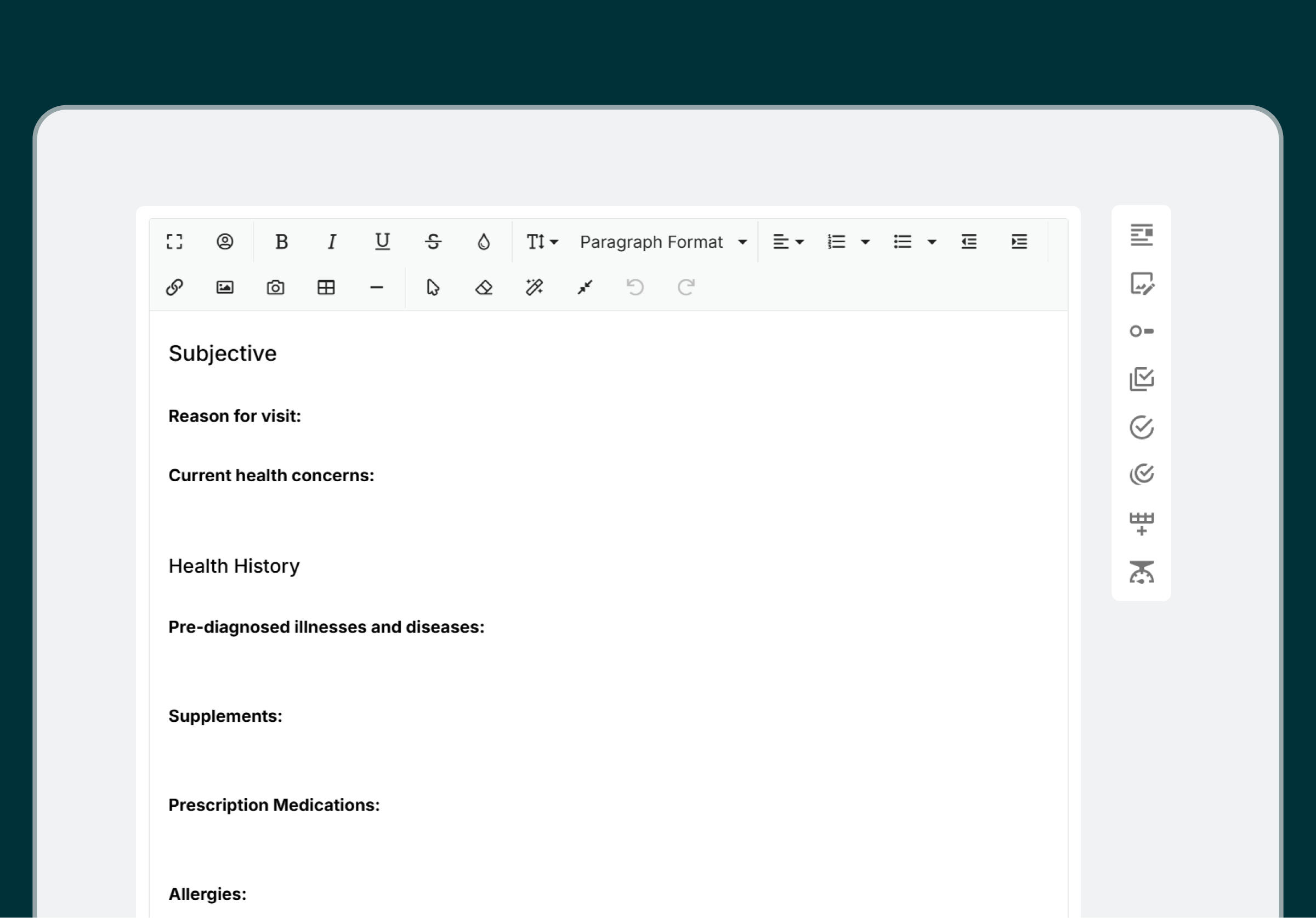
Practice Better lets you choose SOAP, ADIME, DAP, or BIRP, or build a custom note format from scratch (charting). A PIE template is a custom format: three labeled sections, with the prompts from the blank template above.
A few Practice Better features fit the PIE structure well:
PIE stands for Problem, Intervention, and Evaluation. The OpenStax Fundamentals of Nursing textbook defines the PIE method as a form of problem-oriented documentation built from those three parts.
PIE charting is a nursing documentation method in which the nurse identifies the patient's problem, documents the actions taken to address it, and describes the patient's response (OpenStax, section 14.5). OpenStax lists it among the problem-oriented methods alongside SOAP, focused charting, and charting by exception.
Yes. The blank template on this page is free to copy. It holds the three PIE sections with prompts for what goes in each one, and it handles a second problem by repeating the block.
Yes. Practice Better offers SOAP, ADIME, DAP, and BIRP note formats and lets you build a custom note format from scratch (charting), which is how you set up a PIE template. You build it once and reuse it for every session.
Use SOAP when you take measurements at each visit and want them kept in their own section, because SOAP gives objective data a dedicated place. Use PIE when your sessions center on one or two problems and the record needs to show what you did about each and how the client responded.
Copy the blank template, adjust the prompts to your discipline, and save it as a note template so the structure is waiting before the session starts.
Start a free trial of Practice Better to build your PIE note template and chart every session in the format you use.
{{soap-note-template}}
{{free-trial-simple-text}}

PIE notes are clinical notes written in three sections: Problem, Intervention, and Evaluation. The OpenStax Fundamentals of Nursing textbook defines the PIE method as a form of problem-oriented documentation, the same family SOAP belongs to. Each note names the client's problem, records what you did about it, and describes how the client responded (OpenStax, section 14.5).
Below you will find a blank PIE template, a step-by-step method for writing each section, and six worked examples for a dietitian, a health coach, a functional medicine practitioner, and a counselor. Two of the examples are follow-up notes, so you can see the evaluation section close the loop on an earlier session.
Every example here is illustrative. The clients are composites written to demonstrate the format, and none is a real person or a real record.
Each section answers one question, and the three together give a reader the problem, the action, and the result.
| Section | The question it answers | What belongs there |
|---|---|---|
| Problem | What are we working on? | The issue in one or two sentences, with the evidence: the client's words, what you observed, or what their log shows |
| Intervention | What did you do about it? | The actions you took this session: education, a skill practiced, a resource sent, a task assigned |
| Evaluation | How did the client respond? | The client's response to each intervention, and what you will check next time |
OpenStax describes the three parts this way: the problem is what you identify, the intervention is the action taken to address it, and the evaluation is the client's response to that action (OpenStax, section 14.5). The same source names the trade-off. PIE keeps a direct line between each problem and the care provided, and its focus on ongoing evaluation helps when you adapt the care plan, but the level of detail it asks for takes time.
PIE has three sections where SOAP has four. With no separate section for objective data, the evidence for a problem goes into the problem statement itself. If you skip that, the problem reads as an opinion with nothing behind it.
Copy this into your notes system and fill it in during or right after the session. When a session covers a second problem, repeat the block and number it.
PIE NOTE
Client: Date: Session type:
P1 Problem
- Issue, in one or two sentences:
- Evidence (client's words, observation, log or tracker data):
I1 Intervention
- What you did this session (taught, practiced, assigned, sent):
- Detail a colleague would need to repeat it:
E1 Evaluation
- Client's response to each intervention, in session:
- What you will check next time, and when:
(Repeat P2 / I2 / E2 for each additional problem)
Numbering the blocks keeps each evaluation tied to its own problem when one session covers two.
Write the three sections in order, keep each one to its own job, and end with what you will check next time. The four steps below are the full method.
Write the problem in one or two sentences and put the evidence beside it. "Client reports skipping breakfast on workdays" is a problem. "Client is struggling with eating" is a label that the next reader has to decode.
List what you did as specific actions. "Discussed breakfast" leaves a colleague guessing what happened. "Built three workday breakfast options with the client and sent the handout through the client portal" tells them exactly what happened.
Describe how the client responded, using what they said and did. "Tolerated session well" leaves the reader guessing whether the plan landed. "Client chose two of the three options and said the third needs a fridge at work" shows the client engaged with the plan and names the barrier.
Close the evaluation with what you will look at next session and when. That line is what the next note evaluates against, which is how PIE notes build a running record of each problem across visits.
Here are six. The first two follow one dietitian client across two sessions, the last two follow one counseling client the same way, and the functional medicine example shows a note covering two problems.
Composite scenario: initial nutrition session, client wants steadier energy at work.
P: Client reports skipping breakfast on workdays and feeling hungry by mid-morning, then buying snacks from the office vending machine. Eats breakfast on weekends without difficulty. Says mornings are rushed because of school drop-off.
I: Walked through the client's workday morning routine to find where breakfast could fit. Built three grab-and-go breakfast options with the client, each one ready in under five minutes. Sent a breakfast ideas handout through the client portal. Asked the client to log breakfast in the food journal on workdays until the next session.
E: Client chose two of the three options as realistic and said the third needs a fridge at work, which they do not have. Client restated the plan in their own words. Review the food journal at the next session in two weeks, looking at how many workdays include a logged breakfast.
Composite scenario: two weeks later, same client.
P: Continuing: workday breakfast. Food journal shows breakfast logged on seven of ten workdays. Client reports fewer vending machine trips and says the overnight oats option is the one that stuck.
I: Reviewed the food journal with the client. Identified that the three missed days were all Mondays. Planned a Sunday evening prep step for Monday's breakfast. Added a protein-focused variation of the overnight oats at the client's request and sent the recipe through the portal.
E: Client described the change as easier than expected and said Mondays are the remaining gap. Agreed to the Sunday prep step. Check Monday entries specifically at the next session in three weeks.
The follow-up evaluation answers the question the first note asked. Without that line in the first note, the second has nothing to measure against.
Composite scenario: week four of a coaching program, client's goal is daily movement.
P: Client set a goal of a 20-minute walk after dinner and has done it twice in the past two weeks, per their habit tracker. Says evenings are taken up by their children's activities.
I: Explored where in the day the client has a predictable gap. Client identified the lunch break. Moved the walk to lunch on three named weekdays and set a calendar reminder together during the session. Kept the evening walk as an optional weekend activity.
E: Client described the lunch plan as easier to keep than the evening one and named a walking route near the office. Review the habit tracker at the next check-in in one week, counting lunch walks completed against the three planned.
Composite scenario: second visit, digestive complaints and afternoon fatigue. Lab work ordered at the first visit is still pending.
P1: Client reports bloating after meals on five of seven days in the symptom log, worse in the evening. No pattern yet between specific foods and symptoms.
I1: Reviewed the symptom log with the client. Added meal timing and a short food description to each log entry so food and symptom can be matched. Asked the client to keep their current diet unchanged until lab results are reviewed, so any change in symptoms can be read against a stable baseline.
E1: Client agreed to hold diet changes and said the extra log fields are manageable. Review the expanded log alongside lab results at the next visit.
P2: Client reports an energy dip in the mid-afternoon on workdays, managed with a second coffee. Sleep log shows bedtimes varying by up to two hours across the week.
I2: Shared the sleep log pattern with the client. Agreed on a fixed weeknight bedtime, chosen by the client, as a first step. Added a bedtime field to the existing tracker so sleep and energy sit in one log.
E2: Client chose the bedtime and said weekends would be harder to hold. Review the tracker for bedtime consistency and afternoon energy at the next visit, alongside P1.
Numbering lets each evaluation answer its own problem, and the next visit can review P1 and P2 separately.
Composite scenario: session five, client working on work-related worry.
P: Client reports lying awake on weeknights thinking about work email they have not opened. Avoids checking email after 6pm, then worries about what it contains. Describes Sunday evenings as the worst.
I: Gave psychoeducation on how avoidance can keep worry going. Practiced a written worry list in session: client wrote down each work concern and one next step for it. Assigned a 15-minute worry-writing window before dinner on weeknights, with the list kept on paper away from the bedroom.
E: Client completed the worry list in session and said writing it down felt lighter. Expressed doubt about doing it at home on busy evenings. Review the worry list and the client's report of weeknight sleep at the next session in one week.
Composite scenario: session six, same client.
P: Continuing: weeknight worry about work. Client completed the worry-writing window on three of five weeknights. Reports falling asleep faster on those nights by their own account. Missed both days that ran late at work.
I: Reviewed the worry lists with the client and noticed that the same two concerns appeared every night. Worked through a problem-solving step for one of them in session. Adjusted the window to a shorter five-minute version for late workdays.
E: Client engaged with the problem-solving step and chose a first action for the recurring concern. Said the five-minute version felt doable. Review completion on late workdays and progress on the chosen action at the next session in one week.
The evaluation earns its place when it records the client's response to the specific intervention and names what you will check next time. It is the section that separates PIE from a list of things you did.
Three tests work on any evaluation:
Cover the problem and intervention sections and read the evaluation alone. If it still tells you whether the plan is working, it is doing its job.
Both are problem-oriented documentation methods (OpenStax). SOAP splits what the client reported from what you measured and adds a separate assessment and plan. PIE folds the evidence into the problem and puts the weight on how the client responded.
| PIE | SOAP | |
|---|---|---|
| Sections | Problem, Intervention, Evaluation | Subjective, Objective, Assessment, Plan |
| Where measurements go | Inside the problem statement, as evidence | Their own Objective section |
| Where your reasoning goes | The problem statement and the evaluation | The Assessment section |
| What it puts first | The client's response to what you did | The full picture of the session |
| Fits when | Sessions center on one or two problems and the record needs to show action and response | You take measurements each visit and other practitioners read your notes for that data |
If you chart in SOAP today, the SOAP note examples show the same disciplines worked through in that format, and how to write a SOAP note covers each section. Dietitians comparing formats can also read ADIME vs SOAP notes.
Practice Better lets you choose SOAP, ADIME, DAP, or BIRP, or build a custom note format from scratch (charting). A PIE template is a custom format: three labeled sections, with the prompts from the blank template above.
A few Practice Better features fit the PIE structure well:
PIE stands for Problem, Intervention, and Evaluation. The OpenStax Fundamentals of Nursing textbook defines the PIE method as a form of problem-oriented documentation built from those three parts.
PIE charting is a nursing documentation method in which the nurse identifies the patient's problem, documents the actions taken to address it, and describes the patient's response (OpenStax, section 14.5). OpenStax lists it among the problem-oriented methods alongside SOAP, focused charting, and charting by exception.
Yes. The blank template on this page is free to copy. It holds the three PIE sections with prompts for what goes in each one, and it handles a second problem by repeating the block.
Yes. Practice Better offers SOAP, ADIME, DAP, and BIRP note formats and lets you build a custom note format from scratch (charting), which is how you set up a PIE template. You build it once and reuse it for every session.
Use SOAP when you take measurements at each visit and want them kept in their own section, because SOAP gives objective data a dedicated place. Use PIE when your sessions center on one or two problems and the record needs to show what you did about each and how the client responded.
Copy the blank template, adjust the prompts to your discipline, and save it as a note template so the structure is waiting before the session starts.
Start a free trial of Practice Better to build your PIE note template and chart every session in the format you use.
{{soap-note-template}}
{{free-trial-simple-text}}