.jpg)

What we learned from 1,000+ patients in a patient study commissioned by Practice Better and Stripe
The way patients experience your practice isn’t defined by a single visit anymore—it’s shaped by every touchpoint along the way. How easily they can book, what they understand about pricing, and how simple it is to pay all influence whether they feel supported or stressed. For practices, this increasingly depends on whether booking, pricing, and payments are integrated in one consistent digital system rather than spread across tools.
Pro tip: See how the Practice Better Client Portal centralizes booking, communication, and payments.
Our 2025 Patient Booking & Payments Trends Survey shows a clear shift: patients want self-service booking, upfront pricing, and payment options that match their financial realities. And they want all of it delivered through a digital experience that feels easy, intuitive, and consistent.
These expectations now play a major role in who patients choose—and whether they stay.
In this report, we unpack the trends that matter most and share practical steps to help your practice reduce friction, build trust, and support patients at every stage of their journey.
{{free-trial-simple-text}}
Across nearly every question we asked, one theme stood out: patients are tired of guessing the cost of care.
When pricing isn’t clear, patients see it as a red flag—raising concerns about surprise charges and what else might be withheld. Trust starts to erode before the relationship even begins.
What this means for your practice:
Even if your services are complex, offering simple anchors—“starting at” pricing, typical ranges, or packaged options—helps patients understand what to expect. And when your service descriptions, booking flow, and invoices all align, your practice feels consistent and trustworthy. Practices that tie pricing directly to services, booking, and invoices reduce confusion by showing patients the same information at every step.
Pro tip: Link your existing services, packages and programs in Practice Better to your website and require payment information at booking for a seamless checkout experience.
Patients increasingly expect to schedule on their own.
Online self-service channels—portals, websites, and mobile apps—now rank as the #1 preferred way to book (42%), ahead of phone (33%). Within those digital options, patient portals stand out as the single most preferred, with 60% of patients including them in their top three booking methods.Yet patients are using phone and in-person scheduling more than they want to:
Digital channels show the opposite pattern—patients want to use them more than they currently do. This gap suggests barriers like limited availability, confusing interfaces, or difficulty finding the online scheduling option.
Pro tip: Platforms like Practice Better centralize online booking, automated confirmations, and follow-up communications in one place. This allows clients to manage their appointments independently without phone calls or emails, while enabling your practice to stay focused on higher-value, revenue-generating work. See how clients can easily manage bookings in the Client Portal.
.png)
What this means for your practice:
Enhancing your digital booking options—especially in your portal—helps you capture more bookings, reduce call volume, and deliver a better experience from the very first touchpoint.
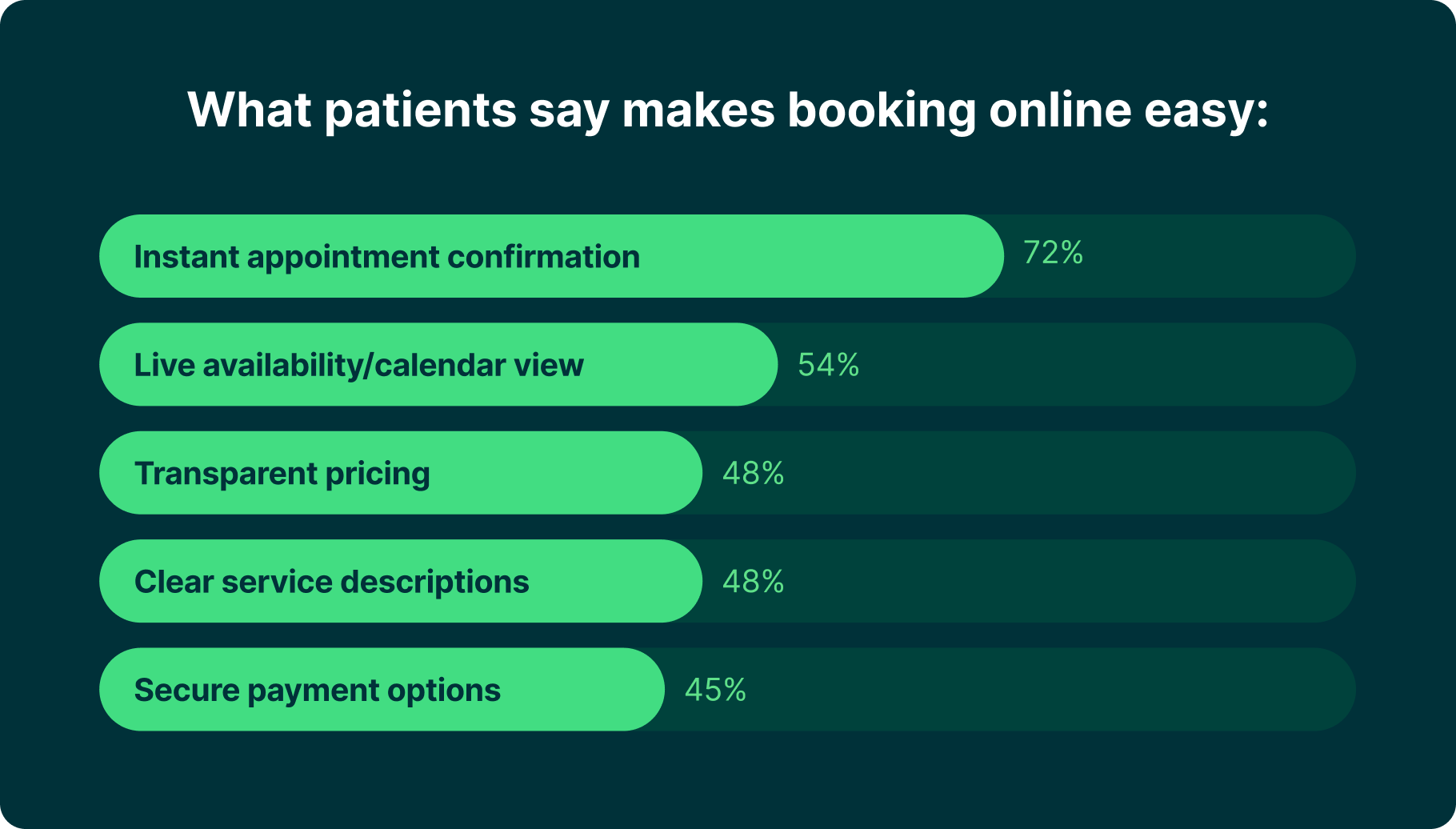
Convenience is becoming one of the strongest predictors of whether a patient will stay with a provider. More than half of patients (54%) say it’s important to be able to fully book and pay online, and 70% say they’re more likely to return to a provider who makes that process easy.
The features that make booking feel “smooth and convenient” all point toward reliable self-service:
These are the foundations of a digital experience that reassures patients, reduces uncertainty, and keeps them moving forward. They work best when booking, confirmations, pricing, and payment collection are part of the same workflow rather than separate systems.
When those foundations falter, patient follow-through does too. Four in ten patients (40%) have abandoned an online booking altogether, most often due to perceived technical issues (53%), unclear service details (24%), or pricing that isn’t explained upfront (23%).
What this means for your practice:
Think of your booking and payment flow as a digital front desk. It should:
When these workflows feel organized and intuitive, patients feel supported before your first session. When they don’t, you’re not just creating inconvenience—you’re losing appointments you may never get back.
The same expectations that drive patients toward self-service scheduling now shape what they want at checkout. Traditional payment habits are shifting: card payments are still the most common, but digital wallets are gaining momentum; 37% prefer options like Apple Pay or Google Pay, even though actual usage still lags at 31%.
And the desire for flexibility goes further.
One in four patients say the lack of flexible payment options, such as installments or digital wallets, is a major frustration. A full 75% say it’s important for providers to offer flexible payment plans, a preference that aligns with rising interest in Buy Now, Pay Later (BNPL): 22% say they’re likely to consider it for future care.
What this means for your practice:
Patients expect payment options that align with both their preferences and their financial realities..Patients expect payment options that fit their preferences and budgets—from insurance and credit cards to tap-to-pay and flexible payment plans.
Practice Better Payments makes it easy to offer all of these options—credit cards, digital wallets, bank debits, and Buy Now, Pay Later—through one fully integrated system. You get more flexibility without added complexity, making it easier for clients and patients to say yes to care.
{{free-trial-simple-text}}
Young adults (18–29) don’t just follow the broader trends—they accelerate them. They’re the most likely to expect a complete digital flow, with 75% saying full online booking and payment is important (vs 54% of all respondents).
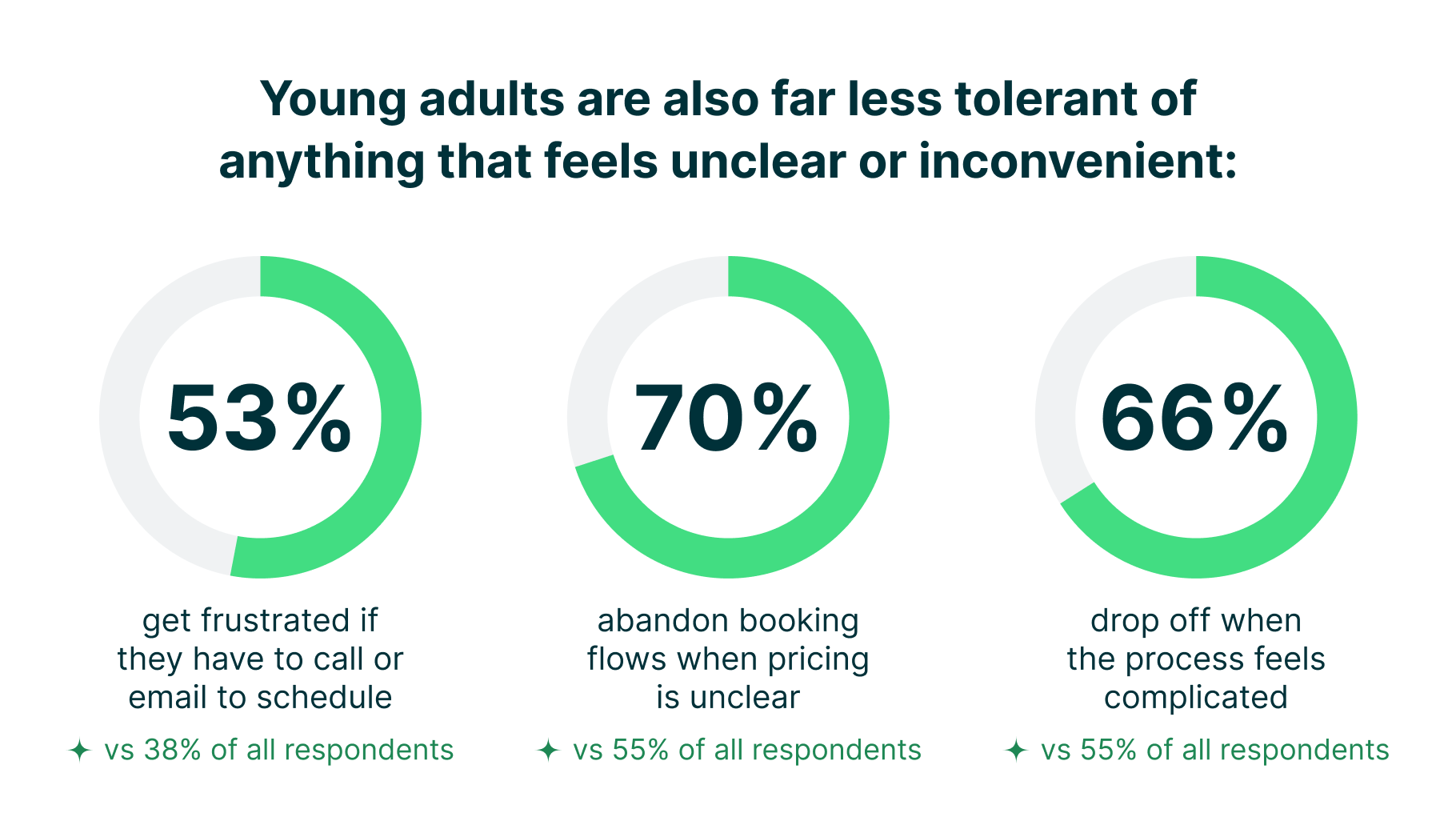
Compared to all respondents, young adults are also far less tolerant of anything that feels unclear or inconvenient:
Payments follow a similar pattern. Their demand for flexible payment plans is much higher (89% vs 75%), and their preference for digital and mobile payments is significantly stronger (51% vs 31%). They’re also more interested in using Buy Now, Pay Later (BNPL) to pay for their care (31% vs 22%).
And critically, they’re more willing to walk away. Nearly one-third switched providers in the last year (29% vs 20%), and they were more than twice as likely to leave because they found a better booking or payment experience elsewhere (24% vs 11%).
What this means for your practice
Younger adults reflect where the entire market is headed: more digital, more transparent, more intuitive, and far less forgiving of friction. They expect mobile-friendly booking and payment flows that can be completed quickly without switching channels. Designing your booking and payment systems to meet their expectations future-proofs your practice and improves the experience for every age group.
You don’t need to rebuild everything at once. Small, focused changes can move you much closer to what patients say they want.
Discover the best practices for converting website visitors to paying customers
With booking, communication, records, and payments all inside one connected system, Practice Better makes it easy to offer the modern experience that patients are asking for:
With Practice Better Payments, powered by Stripe, you can make paying just as simple:
If you want to attract and retain patients—and be ready for the expectations of the next generation—the way people book and pay for care can’t be an afterthought. It’s part of the care you provide.
See how Practice Better and Stripe can help you build a smoother, more patient-friendly booking and payment experience.
{{free-trial-simple-text}}
What we learned from 1,000+ patients in a patient study commissioned by Practice Better and Stripe
The way patients experience your practice isn’t defined by a single visit anymore—it’s shaped by every touchpoint along the way. How easily they can book, what they understand about pricing, and how simple it is to pay all influence whether they feel supported or stressed. For practices, this increasingly depends on whether booking, pricing, and payments are integrated in one consistent digital system rather than spread across tools.
Pro tip: See how the Practice Better Client Portal centralizes booking, communication, and payments.
Our 2025 Patient Booking & Payments Trends Survey shows a clear shift: patients want self-service booking, upfront pricing, and payment options that match their financial realities. And they want all of it delivered through a digital experience that feels easy, intuitive, and consistent.
These expectations now play a major role in who patients choose—and whether they stay.
In this report, we unpack the trends that matter most and share practical steps to help your practice reduce friction, build trust, and support patients at every stage of their journey.
{{free-trial-simple-text}}
Across nearly every question we asked, one theme stood out: patients are tired of guessing the cost of care.
When pricing isn’t clear, patients see it as a red flag—raising concerns about surprise charges and what else might be withheld. Trust starts to erode before the relationship even begins.
What this means for your practice:
Even if your services are complex, offering simple anchors—“starting at” pricing, typical ranges, or packaged options—helps patients understand what to expect. And when your service descriptions, booking flow, and invoices all align, your practice feels consistent and trustworthy. Practices that tie pricing directly to services, booking, and invoices reduce confusion by showing patients the same information at every step.
Pro tip: Link your existing services, packages and programs in Practice Better to your website and require payment information at booking for a seamless checkout experience.
Patients increasingly expect to schedule on their own.
Online self-service channels—portals, websites, and mobile apps—now rank as the #1 preferred way to book (42%), ahead of phone (33%). Within those digital options, patient portals stand out as the single most preferred, with 60% of patients including them in their top three booking methods.Yet patients are using phone and in-person scheduling more than they want to:
Digital channels show the opposite pattern—patients want to use them more than they currently do. This gap suggests barriers like limited availability, confusing interfaces, or difficulty finding the online scheduling option.
Pro tip: Platforms like Practice Better centralize online booking, automated confirmations, and follow-up communications in one place. This allows clients to manage their appointments independently without phone calls or emails, while enabling your practice to stay focused on higher-value, revenue-generating work. See how clients can easily manage bookings in the Client Portal.
What this means for your practice:
Enhancing your digital booking options—especially in your portal—helps you capture more bookings, reduce call volume, and deliver a better experience from the very first touchpoint.
Convenience is becoming one of the strongest predictors of whether a patient will stay with a provider. More than half of patients (54%) say it’s important to be able to fully book and pay online, and 70% say they’re more likely to return to a provider who makes that process easy.
The features that make booking feel “smooth and convenient” all point toward reliable self-service:
These are the foundations of a digital experience that reassures patients, reduces uncertainty, and keeps them moving forward. They work best when booking, confirmations, pricing, and payment collection are part of the same workflow rather than separate systems.
When those foundations falter, patient follow-through does too. Four in ten patients (40%) have abandoned an online booking altogether, most often due to perceived technical issues (53%), unclear service details (24%), or pricing that isn’t explained upfront (23%).
What this means for your practice:
Think of your booking and payment flow as a digital front desk. It should:
When these workflows feel organized and intuitive, patients feel supported before your first session. When they don’t, you’re not just creating inconvenience—you’re losing appointments you may never get back.
The same expectations that drive patients toward self-service scheduling now shape what they want at checkout. Traditional payment habits are shifting: card payments are still the most common, but digital wallets are gaining momentum; 37% prefer options like Apple Pay or Google Pay, even though actual usage still lags at 31%.
And the desire for flexibility goes further.
One in four patients say the lack of flexible payment options, such as installments or digital wallets, is a major frustration. A full 75% say it’s important for providers to offer flexible payment plans, a preference that aligns with rising interest in Buy Now, Pay Later (BNPL): 22% say they’re likely to consider it for future care.
What this means for your practice:
Patients expect payment options that align with both their preferences and their financial realities..Patients expect payment options that fit their preferences and budgets—from insurance and credit cards to tap-to-pay and flexible payment plans.
Practice Better Payments makes it easy to offer all of these options—credit cards, digital wallets, bank debits, and Buy Now, Pay Later—through one fully integrated system. You get more flexibility without added complexity, making it easier for clients and patients to say yes to care.
{{free-trial-simple-text}}
Young adults (18–29) don’t just follow the broader trends—they accelerate them. They’re the most likely to expect a complete digital flow, with 75% saying full online booking and payment is important (vs 54% of all respondents).
Compared to all respondents, young adults are also far less tolerant of anything that feels unclear or inconvenient:
Payments follow a similar pattern. Their demand for flexible payment plans is much higher (89% vs 75%), and their preference for digital and mobile payments is significantly stronger (51% vs 31%). They’re also more interested in using Buy Now, Pay Later (BNPL) to pay for their care (31% vs 22%).
And critically, they’re more willing to walk away. Nearly one-third switched providers in the last year (29% vs 20%), and they were more than twice as likely to leave because they found a better booking or payment experience elsewhere (24% vs 11%).
What this means for your practice
Younger adults reflect where the entire market is headed: more digital, more transparent, more intuitive, and far less forgiving of friction. They expect mobile-friendly booking and payment flows that can be completed quickly without switching channels. Designing your booking and payment systems to meet their expectations future-proofs your practice and improves the experience for every age group.
You don’t need to rebuild everything at once. Small, focused changes can move you much closer to what patients say they want.
Discover the best practices for converting website visitors to paying customers
With booking, communication, records, and payments all inside one connected system, Practice Better makes it easy to offer the modern experience that patients are asking for:
With Practice Better Payments, powered by Stripe, you can make paying just as simple:
If you want to attract and retain patients—and be ready for the expectations of the next generation—the way people book and pay for care can’t be an afterthought. It’s part of the care you provide.
See how Practice Better and Stripe can help you build a smoother, more patient-friendly booking and payment experience.
{{free-trial-simple-text}}