TL;DR If you're still managing your practice with four or five separate tools, it's time to realize the true cost — not only in subscription fees, but in wasted time, distracted focus, compliance risks, and lost revenue that vanish unnoticed. In this post, discover the five hidden dangers of a fragmented tech stack and see how switching to a truly all-in-one platform like Practice Better will reclaim your valuable hours every week and allow you to double down on what matters most: exceptional client care.
There's a version of your practice that runs on a spreadsheet, a scheduling app, a separate telehealth tool, a third-party billing platform, and a client portal you added when the other one stopped working. Each tool solved a real problem when you signed up. Together, they've quietly become a part-time job.
This is the "good enough" tech stack. And if you're a solo or small-group practitioner, there's a good chance you're living in one right now.
These tools aren't inherently bad — but their fragmentation comes at a silent, accumulating cost. Most of it remains hidden until it drains your resources and momentum. Stop ignoring it. Take control before your tech stack controls you.
What is a "good enough" tech stack for a small practice? A "good enough" tech stack is a collection of two or more separate software tools that handle different parts of a health practice — scheduling, documentation, billing, telehealth, messaging — without sharing data or workflows. It feels functional until you add up the time, cost, and risk of keeping it running.
{{free-trial-simple-text}}
Every disconnected tool in your stack requires manual input somewhere. Client books an appointment in your scheduler? You re-enter their info in your notes app. Session ends? You copy billing details into a separate invoicing tool. Intake form comes in? You transcribe it into your EHR.
None of this feels like a crisis in the moment. But 15 minutes here and 20 minutes there add up fast — and for most practitioners, it's significantly more than that. Time spent on data entry and cross-referencing between tools is time you're not spending on clients, on growth, or on anything else that actually moves your practice forward.
When everything lives in one platform, that overhead disappears.
Every time you shift from one app to another, your brain pays a switching cost. Research from UC Irvine found that interruptions significantly increase stress and frustration, even when people manage to complete tasks on time. In a typical practice day — jumping between your scheduler, notes, messaging, and billing — you might switch contexts a dozen times.
This isn't just inefficient. It's exhausting. And it's a significant reason practitioners feel burned out at the end of the day, even on relatively light client loads.
When everything lives in one platform, you stop switching. You open Practice Better and your full day — appointments, notes, messages, and billing — is right there.
When your client data is split across three platforms, you don't actually know how your practice is performing. You have fragments.
What's your average client retention rate? How many active clients do you have right now versus 90 days ago? Which packages are generating the most revenue? Which referral sources convert best?
If answering any of these requires you to pull data from multiple places and stitch it together manually, you're flying blind on the decisions that actually drive growth. Practice Better's reporting keeps your financial and client data in one place, so you can see your practice clearly without a spreadsheet archaeology project.
HIPAA compliance isn't just about your EHR. It applies to every tool that touches protected health information (PHI) — including your scheduling app, messaging tool, payment processor, and telehealth platform.
Many practitioners assume the tools they're using are HIPAA-compliant. Some are. Some offer it only on higher-tier plans. Some require a Business Associate Agreement (BAA) that was never signed. And some tools aren't designed for healthcare at all — they're general-purpose business software being used in a clinical context.
With a fragmented stack, you may have compliance gaps you don't know about. With Practice Better, HIPAA compliance and BAA coverage are built into the platform across scheduling, telehealth, messaging, documentation, and billing.
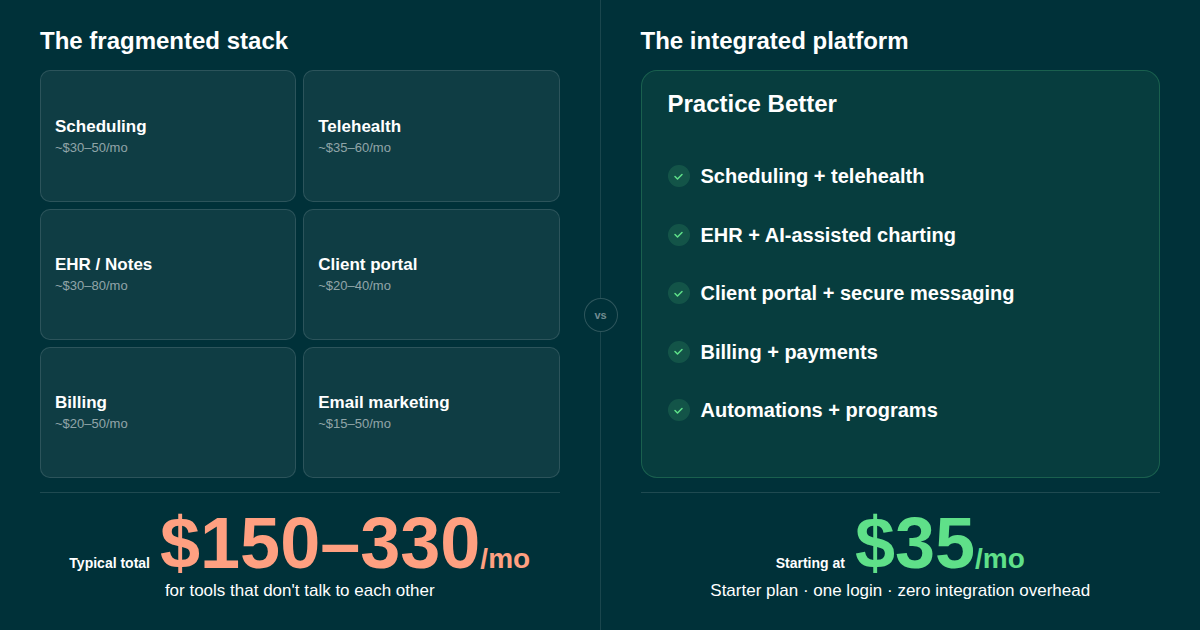
When did you last audit what you're actually paying for? A typical fragmented stack for a small wellness practice might include:
Those are typical market ranges — and they add up to somewhere between $150–330/month, or $1,800–3,960/year, for tools that don't talk to each other and require your time to manage. Practice Better consolidates all of this into a single platform, typically at a lower combined cost, with none of the integration overhead.
{{free-trial-simple-text}}
Before: Maya is a registered dietitian running a solo practice. She uses Calendly for scheduling, a separate EHR for notes and client information, a standalone telehealth tool, Wave for invoicing, and Gmail for client communication. On a typical Monday, she spends 30 minutes before her first client re-entering appointment notes, reconciling last week's invoices, and hunting for an intake form that a new client swears they submitted. By noon, she's seen three clients and already feels behind.
After: Maya moves everything to Practice Better. Her clients book appointments, receive intake forms, complete telehealth sessions, get notes summaries, and pay invoices — all in one portal. She starts her Monday by reviewing a single dashboard. By noon, she's seen the same three clients, has 45 minutes to work on her new group program, and hasn't opened a second tab to do it. Same practice. Same clients. Completely different day.
Practice Better isn't just an EHR. It's a full practice operating system built specifically for dietitians, nutritionists, health coaches, and functional medicine practitioners. On a single platform, you get:
One login. One monthly fee. Zero integration overhead required.
"Isn't migration kind of a nightmare?" Practice Better offers concierge migration support to help you move client data and rebuild your workflows.
"What if my team has a learning curve?" The platform is designed for busy practitioners, not IT departments. Most users are confident in their core workflows within a week or two, and live support is available when needed.
"What about the tools I already love?" Practice Better integrates with popular tools, including Fullscript, Stripe, Zoom, and more — so you keep the connections that matter while eliminating the redundant ones.
"Is it really more affordable?" For most practices running three or more separate tools, Practice Better is less expensive in subscription costs alone, before you factor in the time savings.
The "good enough" stack made sense when you were getting started. But if you're growing, it's working against you — in time, in energy, and in revenue you're not capturing.
Practice Better brings scheduling, documentation, telehealth, billing, messaging, and automations under one roof — purpose-built for health and wellness practitioners.
{{free-trial-simple-text}}

TL;DR If you're still managing your practice with four or five separate tools, it's time to realize the true cost — not only in subscription fees, but in wasted time, distracted focus, compliance risks, and lost revenue that vanish unnoticed. In this post, discover the five hidden dangers of a fragmented tech stack and see how switching to a truly all-in-one platform like Practice Better will reclaim your valuable hours every week and allow you to double down on what matters most: exceptional client care.
There's a version of your practice that runs on a spreadsheet, a scheduling app, a separate telehealth tool, a third-party billing platform, and a client portal you added when the other one stopped working. Each tool solved a real problem when you signed up. Together, they've quietly become a part-time job.
This is the "good enough" tech stack. And if you're a solo or small-group practitioner, there's a good chance you're living in one right now.
These tools aren't inherently bad — but their fragmentation comes at a silent, accumulating cost. Most of it remains hidden until it drains your resources and momentum. Stop ignoring it. Take control before your tech stack controls you.
What is a "good enough" tech stack for a small practice? A "good enough" tech stack is a collection of two or more separate software tools that handle different parts of a health practice — scheduling, documentation, billing, telehealth, messaging — without sharing data or workflows. It feels functional until you add up the time, cost, and risk of keeping it running.
{{free-trial-simple-text}}
Every disconnected tool in your stack requires manual input somewhere. Client books an appointment in your scheduler? You re-enter their info in your notes app. Session ends? You copy billing details into a separate invoicing tool. Intake form comes in? You transcribe it into your EHR.
None of this feels like a crisis in the moment. But 15 minutes here and 20 minutes there add up fast — and for most practitioners, it's significantly more than that. Time spent on data entry and cross-referencing between tools is time you're not spending on clients, on growth, or on anything else that actually moves your practice forward.
When everything lives in one platform, that overhead disappears.
Every time you shift from one app to another, your brain pays a switching cost. Research from UC Irvine found that interruptions significantly increase stress and frustration, even when people manage to complete tasks on time. In a typical practice day — jumping between your scheduler, notes, messaging, and billing — you might switch contexts a dozen times.
This isn't just inefficient. It's exhausting. And it's a significant reason practitioners feel burned out at the end of the day, even on relatively light client loads.
When everything lives in one platform, you stop switching. You open Practice Better and your full day — appointments, notes, messages, and billing — is right there.
When your client data is split across three platforms, you don't actually know how your practice is performing. You have fragments.
What's your average client retention rate? How many active clients do you have right now versus 90 days ago? Which packages are generating the most revenue? Which referral sources convert best?
If answering any of these requires you to pull data from multiple places and stitch it together manually, you're flying blind on the decisions that actually drive growth. Practice Better's reporting keeps your financial and client data in one place, so you can see your practice clearly without a spreadsheet archaeology project.
HIPAA compliance isn't just about your EHR. It applies to every tool that touches protected health information (PHI) — including your scheduling app, messaging tool, payment processor, and telehealth platform.
Many practitioners assume the tools they're using are HIPAA-compliant. Some are. Some offer it only on higher-tier plans. Some require a Business Associate Agreement (BAA) that was never signed. And some tools aren't designed for healthcare at all — they're general-purpose business software being used in a clinical context.
With a fragmented stack, you may have compliance gaps you don't know about. With Practice Better, HIPAA compliance and BAA coverage are built into the platform across scheduling, telehealth, messaging, documentation, and billing.
When did you last audit what you're actually paying for? A typical fragmented stack for a small wellness practice might include:
Those are typical market ranges — and they add up to somewhere between $150–330/month, or $1,800–3,960/year, for tools that don't talk to each other and require your time to manage. Practice Better consolidates all of this into a single platform, typically at a lower combined cost, with none of the integration overhead.
{{free-trial-simple-text}}
Before: Maya is a registered dietitian running a solo practice. She uses Calendly for scheduling, a separate EHR for notes and client information, a standalone telehealth tool, Wave for invoicing, and Gmail for client communication. On a typical Monday, she spends 30 minutes before her first client re-entering appointment notes, reconciling last week's invoices, and hunting for an intake form that a new client swears they submitted. By noon, she's seen three clients and already feels behind.
After: Maya moves everything to Practice Better. Her clients book appointments, receive intake forms, complete telehealth sessions, get notes summaries, and pay invoices — all in one portal. She starts her Monday by reviewing a single dashboard. By noon, she's seen the same three clients, has 45 minutes to work on her new group program, and hasn't opened a second tab to do it. Same practice. Same clients. Completely different day.
Practice Better isn't just an EHR. It's a full practice operating system built specifically for dietitians, nutritionists, health coaches, and functional medicine practitioners. On a single platform, you get:
One login. One monthly fee. Zero integration overhead required.
"Isn't migration kind of a nightmare?" Practice Better offers concierge migration support to help you move client data and rebuild your workflows.
"What if my team has a learning curve?" The platform is designed for busy practitioners, not IT departments. Most users are confident in their core workflows within a week or two, and live support is available when needed.
"What about the tools I already love?" Practice Better integrates with popular tools, including Fullscript, Stripe, Zoom, and more — so you keep the connections that matter while eliminating the redundant ones.
"Is it really more affordable?" For most practices running three or more separate tools, Practice Better is less expensive in subscription costs alone, before you factor in the time savings.
The "good enough" stack made sense when you were getting started. But if you're growing, it's working against you — in time, in energy, and in revenue you're not capturing.
Practice Better brings scheduling, documentation, telehealth, billing, messaging, and automations under one roof — purpose-built for health and wellness practitioners.
{{free-trial-simple-text}}